Pillar 10 · Cluster 1
GBS transition strategy and planning
Transitioning work from local operations to a GBS center is the defining moment of shared services. The methodology, due diligence, and governance you apply determine whether the transition delivers value or creates chaos.
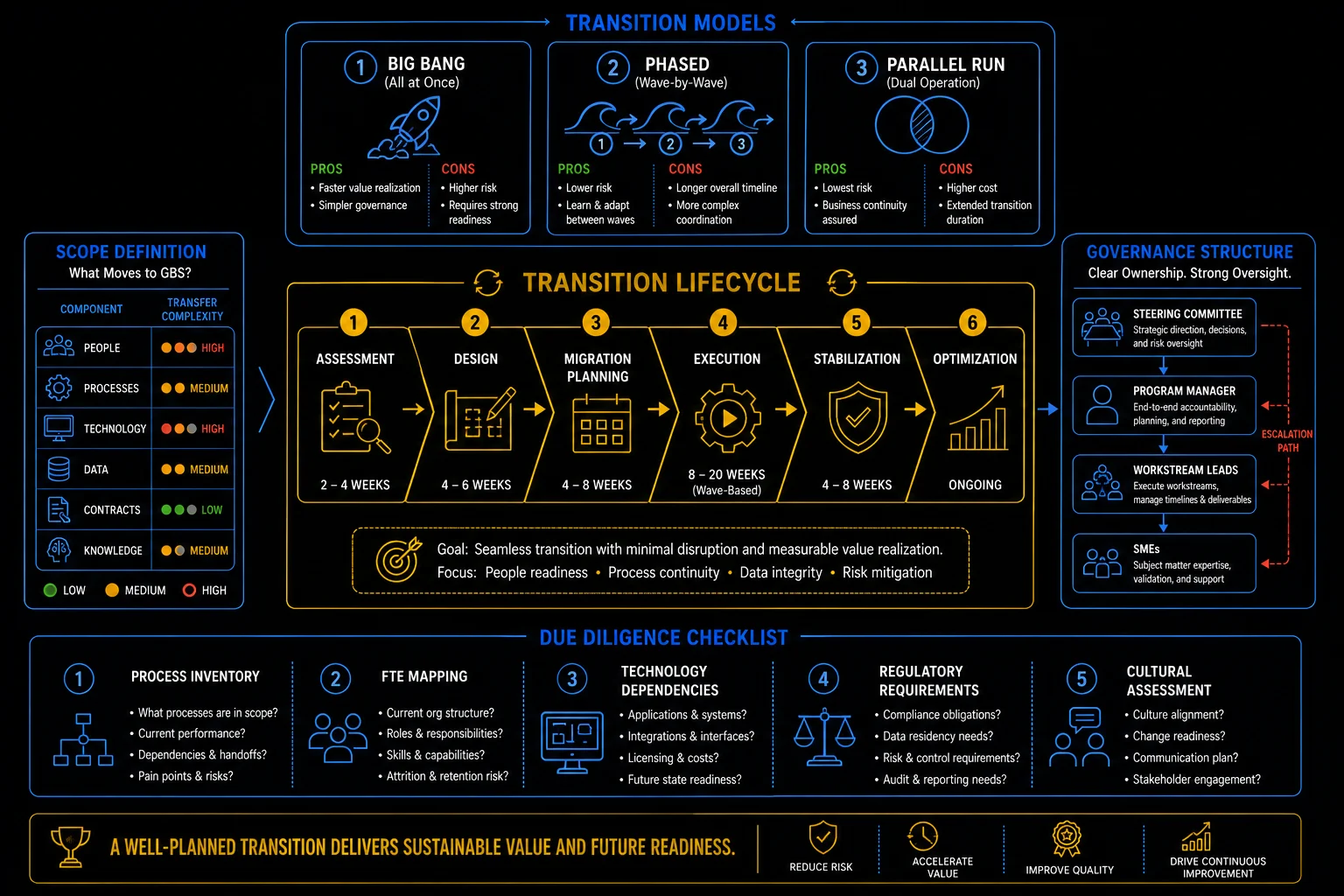
Transition strategy — models, lifecycle, governance, and due diligence
Sound familiar?
Topic 01 · Methodology
Lift and Shift vs Transform and Transfer
Lift-and-shift moves the process as-is, then improves; transform changes it during the move. The choice sets the whole project’s risk profile. Read how to solve this in the section below!
Move it as-is, or fix it in flight?
Pick your risk.
 P
PPriya’s migration steering debates for an hour: clean up the process during the move, or move first and fix later?
The veteran in the room ends it: "Change the place or change the process. Changing both at once is how transitions fail."
Lift-and-shift wins. Improvement gets its own phase — after stability.
"One variable at a time. Even in transformations."
She feels settled about a call she could now defend.
You bundle relocation and redesign to save time — and double the failure modes instead.
Two strategies, one honest trade.
The as-is move stabilizes in weeks. The improvement backlog starts from a running process, not a wobbling one.
Lift-and-shift vs transform in depth
The fundamental strategic choice: move the process as-is and improve later, or redesign before migrating. Each approach has trade-offs in speed, risk, and long-term value.
Every organization standing up a GBS faces the same binary choice: migrate first and improve later, or redesign first and migrate to the new standard.
- The choice shapes your program timeline and risk profile
- It drives your change management approach — one change cycle vs two
- Ultimately determines whether GBS runs as a cost center or a transformation engine
Lift and Shift
12–18 monthsTransform and Transfer
18–30 months| Dimension | Lift and Shift | Transform and Transfer |
|---|---|---|
| Time to first value | 3–4 months | 6–10 months |
| Total duration | 12–18 months | 18–30 months |
| Upfront investment | Lower | Higher |
| Long-term savings | Moderate | Higher |
| Process debt risk | High | Low |
| Automation readiness | Delayed | Immediate |
| Typical failure mode | Debt never resolved | Analysis paralysis |
Most successful GBS transformations use a hybrid: transform and transfer as the strategic frame, with tactical lift and shift for early waves to build credibility.
- You earn board credibility in Wave 1 and spend it on the design time you need for the harder towers
- Pure transform and transfer from day one is how you get funding pulled in month nine — the board sees no results
- For first-wave transitions, Lift and Shift is usually safer — establish credibility with reliable delivery, then improve. Trying to transform and transition simultaneously doubles the risk.
- For subsequent waves, Transform and Transfer makes more sense — you have the operational maturity to absorb change, and stakeholders have seen the GBS model work.
- The worst outcome is an unofficial hybrid: claiming Lift and Shift but allowing ad-hoc process changes during transition without formal change control.
- Wave sequencing matters: start with high-volume, low-complexity processes to build momentum and credibility before tackling complex, exception-heavy towers.
For any move you are near: name which strategy it runs. If both at once — ask who decided that.
Strategy chosen. Now verify the scope actually is what everyone claims.
Topic 02 · Scoping
Due diligence and scope validation
Due diligence validates what the process really is before committing to move it. The documented process and the real one always differ. Read how to solve this in the section below!
The handbook says four steps.
The team runs eleven.
 K
KKlaudia validates scope for an incoming process. The documentation: clean, four steps, two systems.
Two days of shadowing the sending team: eleven real steps, four side systems, three undocumented workarounds, one person doing "a bit extra" nobody mentioned.
The transition plan was built on the four-step fiction.
"We almost signed up to move a process that does not exist."
She feels vindicated for insisting on the shadowing days.
You size the transition on documentation and inherit the undocumented reality at go-live.
Due diligence is verification in person.
The plan grows to fit reality before commitment — a hard conversation in week two instead of a crisis in month four.
Due diligence and scope validation in depth
Before committing to a transition, you need to know exactly what you are taking on — volume, complexity, exceptions, dependencies, and the political landscape.
- Process inventory — document every process in scope with volumes, frequency, FTE count, and system dependencies
- Exception analysis — identify the non-standard cases, workarounds, and manual interventions that formal documentation misses
- Stakeholder mapping — who currently owns the process, who will be affected, and who has veto power
- System access requirements — what ERP roles, application access, and security clearances are needed
- Regulatory constraints — data residency, licensing, language requirements, and country-specific compliance rules
- People implications — impact on existing team (redeployment, redundancy, retention), hiring needs at receiving site
Due diligence always underestimates complexity.
- The formal process documentation shows the happy path.
- The reality includes 47 exception types, 12 manual workarounds, 3 undocumented approvals, and knowledge that exists only in one person's head.
- Build contingency into every timeline and cost estimate. If the due diligence says 6 months, plan for 9.
Due diligence — process, FTE, technology, regulatory, cultural
Before your next handover of any kind: shadow the real work for half a day. Count the undocumented.
Reality validated. Gates keep it honest from here.
Topic 03 · Governance
Transition governance and gate reviews
Transition governance means gates with real criteria — and the authority to say "not yet." A gate nobody can fail is a ceremony. Read how to solve this in the section below!
The gate review passed everything.
That was the warning sign.
 P
PPeter sits in a readiness gate. Criteria half-met, training incomplete — and the date pressure is enormous.
The room leans toward "conditional pass." The transition lead stops it: criteria are criteria.
Go-live moves two weeks. The noise is loud for a day.
"A gate that cannot say no is a rubber stamp with a meeting invite."
He feels respect for the first "not yet" he has seen survive date pressure.
You let the go-live date outrank the readiness criteria — and pay the difference in hypercare.
Real gates have three properties.
The two-week delay lands quietly. The go-live that follows needs half the hypercare anyone budgeted.
Transition governance and gate reviews in depth
Gate reviews are the governance mechanism that prevents transitions from advancing when they are not ready. Each gate requires defined exit criteria to be met before proceeding.
Gate 1 — Scope Approval
Confirm the scope, timeline, resource plan, and business case. Approve the transition charter. Exit criteria: signed-off scope document, approved budget, assigned project team.
Gate 2 — Readiness
Confirm that the receiving team is trained, systems are configured, test scenarios are validated, and operational procedures are documented. Exit criteria: completed KT, successful parallel run, updated SOPs.
Gate 3 — Go-Live
Confirm that Service Acceptance Criteria (SAC) are met, hypercare plan is in place, and escalation paths are defined. Exit criteria: SAC sign-off, hypercare team staffed, rollback plan documented.
Transition lifecycle — assessment through optimization
Read your next gate’s criteria in advance. Ask which ones are binary — and who may say no.
Gates open. Cluster 2: the knowledge must now actually move.
The smartest transition plans invest in both sides — the receiving hub and the retained organization. Most playbooks focus heavily on the team taking over. That makes sense, but the retained team needs just as much clarity.
- They need to know how the new process works and who to contact at the hub
- They need to understand the handoff points and what to expect post-go-live
- When both sides are prepared, transitions land cleaner and stabilize faster
- A clear retained-org playbook is one of the highest-impact things you can advocate for — often the difference between a smooth landing and months of firefighting
Reference
Glossary
Full glossary at the GBS Insider Club Field Guide.
- SSON — GBS Transition Best Practices Guide, 2025
- Deloitte — Shared Services Transition Playbook, 2024
- Everest Group — GBS Transition Assessment Framework, 2025
- McKinsey — Delivering large-scale transformation programs, 2024
Knowing the frameworks is the entry ticket. Applying them — visibly, at your actual job — is what gets you promoted.
The GBS Insider Club Career Playbooks turn this theory into a guided 90-day program for your role: self-assessment, practical exercises, templates, and Julian's unfiltered practitioner playbook.
Explore the Career Playbooks → Back to GBS Transition