Pillar 4 · Cluster 1
Communication skills that drive GBS credibility
GBS operates across time zones, languages, and cultural contexts. The professionals who advance are the ones who communicate clearly, adapt to their audience, and know when to escalate versus when to solve quietly.
Sound familiar?
Topic 01 · Cultural Intelligence
High-context vs low-context communication
High-context cultures carry meaning in relationships and tone; low-context cultures put it all in the words. The same email lands differently in each. Read how to solve this in the section below!
Your email was clear.
That was the problem.
 A
AAmara sends a correction to a counterpart in Tokyo. Direct, factual, three lines.
The reply is polite. Then the requests start routing around her.
A colleague explains: the correction was read as public criticism.
"I said exactly what I meant. That was the mistake."
She feels puzzled — her clearest email caused the most damage.
You write one style for every culture and read silence as agreement.
Two communication systems run in parallel — and GBS sits between them daily.
Her next correction opens with context and lands privately first. Same message, kept relationship.
High-context vs low-context in depth
A direct email that works in Amsterdam can destroy a relationship in Tokyo. Understanding cultural communication styles is operational, not optional.
Edward Hall's framework splits cultures into two communication styles, and GBS teams have to work across both.
- High-context cultures (Japan, India, Arab countries): meaning is embedded in relationships, hierarchy, and unspoken cues.
- Low-context cultures (Germany, Netherlands, USA): communication is explicit, direct, and expects written confirmation.
- GBS teams working across both must adapt their style depending on the audience, not default to their own preference.
Communication norms
- Direct and explicit — say exactly what you mean
- Written confirmation expected for decisions
- Disagreement expressed openly in meetings
- Deadlines are hard commitments
Communication norms
- Indirect and layered — read between the lines
- Verbal agreements carry weight; written follow-up may feel distrustful
- Disagreement expressed privately, after the meeting
- Deadlines are targets; relationship and context can adjust timelines
- The most dangerous assumption in GBS communication is that silence means agreement. In high-context cultures, silence can mean disagreement, discomfort, or deference to hierarchy.
- When in doubt, confirm in writing — but frame it as "summarizing for clarity" not "documenting what you said." The framing matters.
- Build relationships before you need them. In high-context cultures, the relationship determines whether your message gets heard at all.
Written vs verbal — choosing the right channel
Map your three main counterparts: high or low context? Adjust your next email to each.
Style calibrated. Now make sure anyone knows you exist.
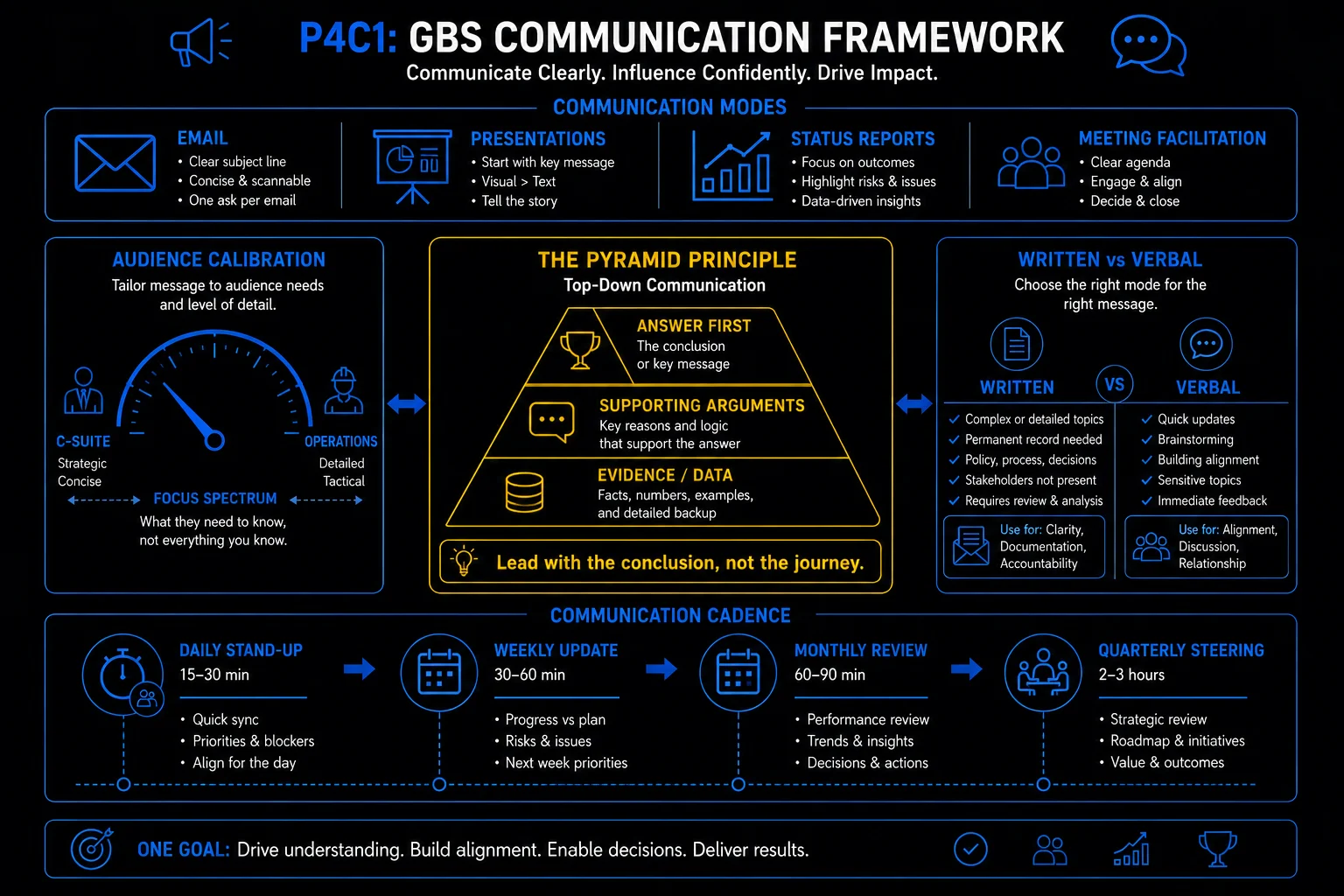
GBS communication framework: lead with the conclusion, not the journey
Topic 02 · Virtual Communication
Virtual presence — being seen and heard remotely
In distributed GBS, your reputation is built on calls and written messages. Presence is a practiced behavior, not a personality trait. Read how to solve this in the section below!
Great work, camera off.
Nobody knows your name.
 R
RRavi joins every call. Mute on, camera off, chat silent.
Month 8 review: "Solid work. Leadership has no visibility of you."
A colleague with half his accuracy gets named in the townhall.
"I thought the work would speak for itself."
He feels invisible — accurately.
Remote work does not hide you. It hides your work — unless you surface it.
Virtual presence is three small behaviors, repeated.
One comment per call, camera on for his topics, a weekly summary in the team channel. Three weeks later, a director uses his name.
Virtual presence in depth
In a GBS center, your reputation is built on video calls and written messages. Virtual presence is built on reliability, clarity, and follow-through.
- Camera on as default — visibility builds trust; exceptions should be the exception, not the rule
- Structured updates — lead with the conclusion, then provide supporting detail (Minto Pyramid principle)
- Active participation — contribute, ask questions, and summarize; silent participants are invisible participants
- Follow-up discipline — action items documented and sent within 24 hours, every time, no exceptions
- Professional environment — background, lighting, and audio quality signal how seriously you take the interaction
In GBS, the people who get promoted are often the people who are visible, not necessarily the people who do the best work. Virtual presence is how you make your contributions visible without being performative.
- Summarize decisions.
- Volunteer for presentations.
- Send structured updates that make your work tangible to stakeholders who never see your daily output.
In your next call, contribute once in the first ten minutes. A sharp question counts.
Seen in the room. Now get read above it.
Topic 03 · Executive Communication
Writing executive summaries and briefings
Senior leaders read the first paragraph and the recommendation. Executive writing puts the answer first and evidence behind it. Read how to solve this in the section below!
Your ten-pager was thorough.
Nobody got past page one.
 K
KKlaudia sends leadership a ten-page analysis. Weeks of work.
The response: "Can you summarize? What do you need from us?"
Her colleague’s one-pager — answer first, three bullets, one ask — gets a decision the same day.
"They did not read my work. They read his answer."
She feels stung — then takes the lesson.
You write the full background before the recommendation. Executives read for the decision first. If they do not find it in the first paragraph, they stop reading.
Executive writing is an inverted pyramid — answer first, always.
Her next brief: one page, answer on top. The decision arrives before lunch.
Executive summaries and briefings in depth
Senior leaders read the first paragraph and the recommendation. Everything else is supporting evidence they may or may not review. Structure accordingly.
Lead with the recommendation
State what you want the reader to do or decide in the first sentence. Do not build up to it. Senior leaders skim — if the answer is buried in paragraph three, they will never find it.
Provide the "so what"
Explain why this matters — the business impact, the risk of inaction, or the opportunity cost. Connect your recommendation to something the executive cares about (revenue, risk, headcount, timeline).
Support with data, not opinion
Use specific numbers, comparisons, and trends. "Processing time increased 23% quarter-over-quarter" is actionable. "Processing is getting slower" is not.
Anticipate objections
Address the two or three most likely pushback points before they are raised. Show you considered alternatives and explain why your recommendation is the strongest option.
Close with clear next steps
Who does what by when. If you need a decision, state the decision needed, the options, and the deadline. Do not leave the reader wondering what happens next.
- Burying the lead — putting context and background before the recommendation
- Data without interpretation — presenting numbers without explaining what they mean for the business
- Too much detail — executive summaries that are neither executive nor summaries
- Passive voice — "it is recommended that" instead of "I recommend" or "the team recommends"
- No ask — ending without a clear request for decision, approval, or action
The Pyramid Principle — lead with the answer
Rewrite your last long email as answer → three bullets → ask. Compare which gets answered faster.
Written for the top. Now write for the clock.
Topic 04 · Distributed Operations
Working across time zones and asynchronous collaboration
Across time zones, synchronous communication is a luxury. Async that works means complete messages, clear owners, documented decisions. Read how to solve this in the section below!
Your stakeholders sleep
while your work moves.
 P
PPriya’s question to Detroit costs a full day per round-trip.
A vague question Monday means an answer Wednesday — after a clarification loop.
She rebuilds the habit: complete context, options included, default stated.
"If you answer nothing, I proceed with Option A on Thursday."
She feels unblocked for the first time in weeks.
You write async messages that need a follow-up question. Each one costs a day.
Good async removes the round-trip.
Round-trips drop from three to one. The time difference becomes a relay, not a wall.
Async collaboration in depth
When your team spans Manila, Krakow, and Detroit, synchronous communication is a luxury. Mastering async work is a core GBS skill.
- Document decisions, not just discussions — if it was decided in a call, it needs a written record accessible to those who were not present
- Overlap windows are scarce — use them for decision-making and problem-solving, not status updates that could be written
- Default to written — video calls should have a purpose that cannot be achieved in writing
- Time zone awareness — never schedule recurring meetings that are consistently inconvenient for the same time zone; rotate the pain
- Handoff protocols — when work passes between time zones, the handoff must include status, blockers, and next actions in writing
- The best GBS teams treat async communication as the default and synchronous meetings as the exception. Most status updates, approvals, and updates do not need a meeting.
- A 30-minute meeting with 8 people across 3 time zones costs 4 hours of productive time. A well-written Slack message or email costs 15 minutes.
Communication cadence — rhythm across time zones
Write your next cross-zone message with options and a default. Count the round-trips it saves.
Messages mastered. Cluster 2: the relationships behind them.
The most common communication failure in GBS — and the most fixable — is assuming everyone thinks and reacts the same way you do. Cultural awareness combined with empathy is the fix, and it's a learnable skill, not something you're born with.
- →Brief yourself before meetings — who is this person, what's their cultural background, what communication style are they likely to expect?
- →Adapt your style to them. Don't wait for them to adapt to yours.
- →When you're new to any stakeholder relationship, asking questions instead of talking is the smartest opening move you can make.
Reference
Glossary
Full glossary at the GBS Insider Club Field Guide.
- Edward T. Hall — Beyond Culture (1976), the foundational framework for high/low-context communication
- Barbara Minto — The Pyramid Principle (1987), standard reference for structured executive communication
- McKinsey — Communication effectiveness in distributed organizations, 2024
- Harvard Business Review — Managing Across Time Zones, 2024
- SSON Analytics — GBS workforce distribution survey, 2025
Knowing the frameworks is the entry ticket. Applying them — visibly, at your actual job — is what gets you promoted.
The GBS Insider Club Career Playbooks turn this theory into a guided 90-day program for your role: self-assessment, practical exercises, templates, and Julian's unfiltered practitioner playbook.
Explore the Career Playbooks → Back to Stakeholder Communication