Pillar 5 · Cluster 1
The performance loop that drives your career
Goal-setting, feedback, self-assessment, and appraisal are not annual events — they are a continuous cycle. The professionals who master this loop control their career trajectory.
Sound familiar?
Topic 01 · Goal Setting
Setting SMART goals that actually matter
A goal you cannot measure cannot be achieved — and a measurable goal that does not matter wastes the year. SMART needs both tests. Read how to solve this in the section below!
"Improve communication skills."
That is a wish, not a goal.
 R
RReview season. Ravi’s goals: "improve Excel," "communicate better," "be more proactive."
Mid-year check: nobody can say whether any of them happened.
His team lead rewrites one with him: "Automate the weekly reconciliation by Q3 — saving four hours per week."
"Now I know what done looks like."
He feels anchored.
Vague goals feel safe because they cannot fail. They also cannot succeed.
SMART is the checklist — with one extra test most people skip.
Three goals, each with a visible finish line. His next review argues itself.
SMART goals in depth — with GBS examples
A goal that cannot be measured cannot be achieved. But a goal that can be measured but does not matter is worse — it wastes effort on vanity metrics.
SMART goals (Specific, Measurable, Achievable, Relevant, Time-bound) are the standard framework, but most GBS professionals apply it poorly.
- →"Improve process efficiency" is not SMART — no measure, no deadline, no method.
- →"Reduce invoice processing cycle time from 5.2 days to 3.8 days by Q3 through implementing automated three-way matching" is SMART.
- →The second version tells you exactly what success looks like, when it happens, and how you will get there.
- Analyst: "Reduce month-end close reconciliation exceptions from 45 to fewer than 20 by end of Q2 by standardizing the intercompany matching template"
- Team Lead: "Achieve 95% SLA compliance for AP processing across all three business units by Q4, measured weekly"
- Project Manager: "Complete UAT sign-off for the ServiceNow HR module migration by March 15, with fewer than 5 critical defects in production"
- Process Owner: "Deliver $250K in validated cost savings through automation of three high-volume manual processes by year-end"
- The most powerful career move in goal-setting is linking your goals to your manager's goals. When your success directly contributes to theirs, you become indispensable.
- Set one stretch goal per cycle that pushes you outside your current skill set. Consistent goal achievement with zero stretch signals you are playing it safe.
OKRs and KPIs — setting goals that count
Rewrite your vaguest goal as verb + object + measure + date. Show it to your team lead.
Goals set the target. The brag sheet proves you hit it.
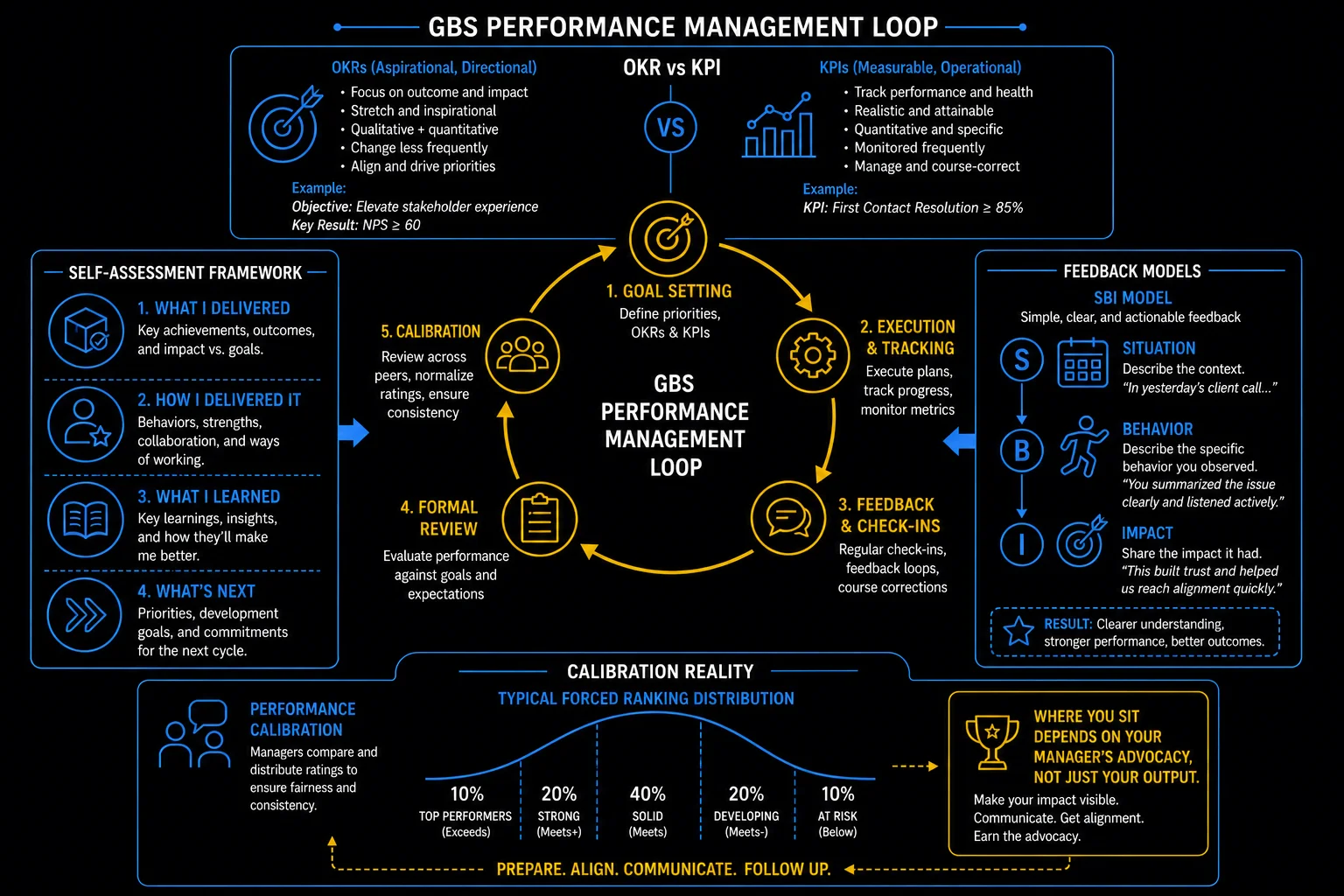
GBS performance management loop: where you sit depends on your manager's advocacy, not just your output
Topic 02 · Achievement Tracking
The brag sheet — tracking wins for appraisals
Your manager will not remember your March win in December. A running brag sheet is the highest-return career habit in GBS. Read how to solve this in the section below!
Your best work from March
is gone by December.
 K
KAppraisal prep. Klaudia’s colleague scrolls months of emails, reconstructing wins from memory.
Klaudia opens one document. Every win, logged the week it happened — with numbers and names.
Her self-assessment takes forty minutes. His takes two evenings and misses half.
"I do not remember my year. I recorded it."
She feels ready while everyone else scrambles.
You trust December-you to remember what March-you did. December-you cannot.
The brag sheet is one line per win, logged weekly.
Appraisals, promotion cases, CV updates — all draw from one living document.
The brag sheet in depth — template and habit
Your manager will not remember your best work from 9 months ago. You need to. A running brag sheet is the single best career investment that takes 5 minutes per week.
- Quantified achievements — "Reduced processing time by 30%" not "improved the process"
- Problems solved — what was broken, what you did, what the outcome was
- Recognition received — emails, Slack messages, mentions from stakeholders or leadership
- Skills developed — new tools learned, certifications completed, training delivered
- Scope expanded — new responsibilities, cross-functional work, projects led or contributed to
- Impact on others — team members mentored, knowledge shared, processes documented for successors
Update your brag sheet every Friday. Five minutes is all it takes.
- →Write down the most impactful thing you accomplished that week, with a number attached if possible.
- →When appraisal season arrives, you have 50 weeks of evidence instead of whatever you can remember from the last two months.
- →This is not self-promotion — it is professional documentation.
Create the document now. Log this week’s win before Friday. One line is enough.
Wins recorded. Now the harder input: criticism.
Topic 03 · Feedback Management
Receiving feedback — recovery and action planning
Tough feedback stings. The professionals who grow fastest process the emotion, extract the actionable core, and show visible change. Read how to solve this in the section below!
The feedback hurt.
The reaction decides everything.
 M
MMiguel’s first leadership feedback: "You micromanage handovers. The team notices."
First instinct: defend, explain, list counterexamples.
He writes the defense — and does not send it. Two days later he reads the feedback again. Half of it is simply true.
"What exactly would I need to change for you to see it differently in 90 days?"
He feels steadier than the feedback deserved.
You spend the feedback conversation defending what you did last quarter instead of using it to shape what happens next. The review is over. The next quarter is where the value is.
The recovery pattern has three moves — in strict order.
At the 90-day mark, the same person names his improvement unprompted. The sting bought something.
Receiving feedback in depth — recovery and action
Tough feedback stings. The professionals who grow fastest are the ones who process the emotion, extract the actionable content, and demonstrate visible change.
Listen without defending
Your first instinct will be to explain or justify. Resist it. Listen fully. Take notes. Ask clarifying questions only to understand, not to argue.
Process the emotion separately
Strong feedback triggers emotional responses. That is normal. Give yourself 24-48 hours before deciding what to do with the feedback. Do not respond in the moment.
Extract the actionable content
Separate the delivery from the message. Even poorly delivered feedback often contains a valid observation. Find the specific behavior or gap being described.
Build an action plan
For each actionable point, define a specific change you will make, how you will measure improvement, and a timeline. Share this plan with your manager.
Demonstrate visible change
The goal is to make the improvement visible to the person who gave the feedback. Close the loop explicitly: "I took your feedback on X and here is what I have changed."
SBI model — Situation, Behavior, Impact
Take your last hard feedback. Extract one true sentence from it. Plan one visible change.
Feedback absorbed. Now write the case for yourself.
Topic 04 · Self-Advocacy
Writing compelling self-assessments
Your self-assessment is your formal argument for the rating or promotion. Treat it as a case: claims, evidence, impact. Read how to solve this in the section below!
Your self-assessment is a case file.
Most people write a diary.
 P
PTwo self-assessments land in calibration.
One: "I worked hard on many initiatives and supported the team."
Peter’s: "Delivered X: 18% faster close, confirmed by Finance. Led Y: zero escalations across the transition."
Guess which one the room can defend.
"Calibration argues with evidence. Give the room evidence."
He feels confident walking out of review season.
You describe effort. Calibration rewards demonstrated impact.
Write it like a case: claim, evidence, impact.
His manager defends his rating in calibration with Peter’s own sentences. That is the assessment doing its job.
Self-assessments in depth — structure and examples
Your self-assessment is your formal argument for why you deserve the rating, the promotion, or the raise. Treat it like a business case, not a diary entry.
- Open with your strongest achievement — the one with the clearest business impact and measurable outcome
- Align to goals — reference each goal set at the beginning of the cycle and describe the specific outcome achieved
- Quantify everything — use numbers, percentages, dollar amounts, and time savings wherever possible
- Acknowledge growth areas honestly — name one area where you are actively developing; this shows self-awareness, not weakness
- Close with forward intent — state what you want to achieve next cycle and how it connects to the team and business direction
Calibration — how your rating actually gets decided
Draft one claim-evidence-impact block from your best win this quarter. Save it for review season.
The loop closes. Cluster 2: where it takes you.
- Your self-assessment is not a diary — it is a marketing document. Write it as if your skip-level manager will read it, because during calibration, they probably will. Lead with measurable impact, not effort.
- Calibration sessions are political. Your manager walks into a room with 8 other managers and fights for your rating against their team members. The managers who win those fights are the ones whose people gave them hard evidence — numbers, stakeholder feedback, project outcomes. Give your manager ammunition.
- If you only hear feedback during your annual review, your manager is failing you — but you can fix it. Ask for monthly 15-minute check-ins. "Am I on track?" is the most powerful career question nobody asks often enough.
Reference
Glossary
Full glossary at the GBS Insider Club Field Guide.
- Gallup — State of the Global Workplace report, 2025
- Harvard Business Review — The Feedback Fallacy, 2019
- Deloitte — Performance management redesign survey, 2024
- SHRM — Goal-Setting Best Practices, 2024
Knowing the frameworks is the entry ticket. Applying them — visibly, at your actual job — is what gets you promoted.
The GBS Insider Club Career Playbooks turn this theory into a guided 90-day program for your role: self-assessment, practical exercises, templates, and Julian's unfiltered practitioner playbook.
Explore the Career Playbooks → Back to Career and Performance