Pillar 5 · Cluster 3
Personal branding for GBS professionals
Your professional reputation is built through visibility, consistency, and demonstrated expertise. Personal branding is not self-promotion — it is making your value obvious to the people who influence your career.
Sound familiar?
Topic 01 · Digital Presence
LinkedIn strategy for GBS professionals
Your LinkedIn profile speaks for you when you are not in the room. Headline, summary, and evidence decide what it says. Read how to solve this in the section below!
Your profile speaks
when you are not in the room.
 K
KA recruiter searches for automation-minded GBS analysts. Klaudia’s profile says "Senior Associate at [Company]."
Nothing about the dashboards. Nothing about the process work. Title, company, silence.
The recruiter moves on in four seconds.
"My profile describes my seat, not my work."
She feels unseen — by design, accidentally.
Your profile lists your job title while recruiters search for your skills.
Three fields do the work — headline, summary, evidence.
Rewritten in one evening. The next search finds her — because the profile finally says what she does.
LinkedIn strategy in depth
Your LinkedIn profile is your public professional resume. It speaks for you when you are not in the room.
- Headline — use your role plus value proposition, not just job title: "GBS Finance Lead | Process Automation | Driving operational efficiency across EMEA"
- About section — write in first person, describe what you do, who you serve, and the impact you create
- Experience — quantify achievements: "$2M in annual savings through AP automation" not "responsible for accounts payable"
- Content engagement — comment thoughtfully on industry posts weekly; share one original perspective per month
- Network strategically — connect with GBS leaders, transformation consultants, and professionals in your target career path
Visibility — being known for the right things
Rewrite your headline: skill + domain, no bare title. Ten words maximum.
The outside sees you now. The inside game matters more.
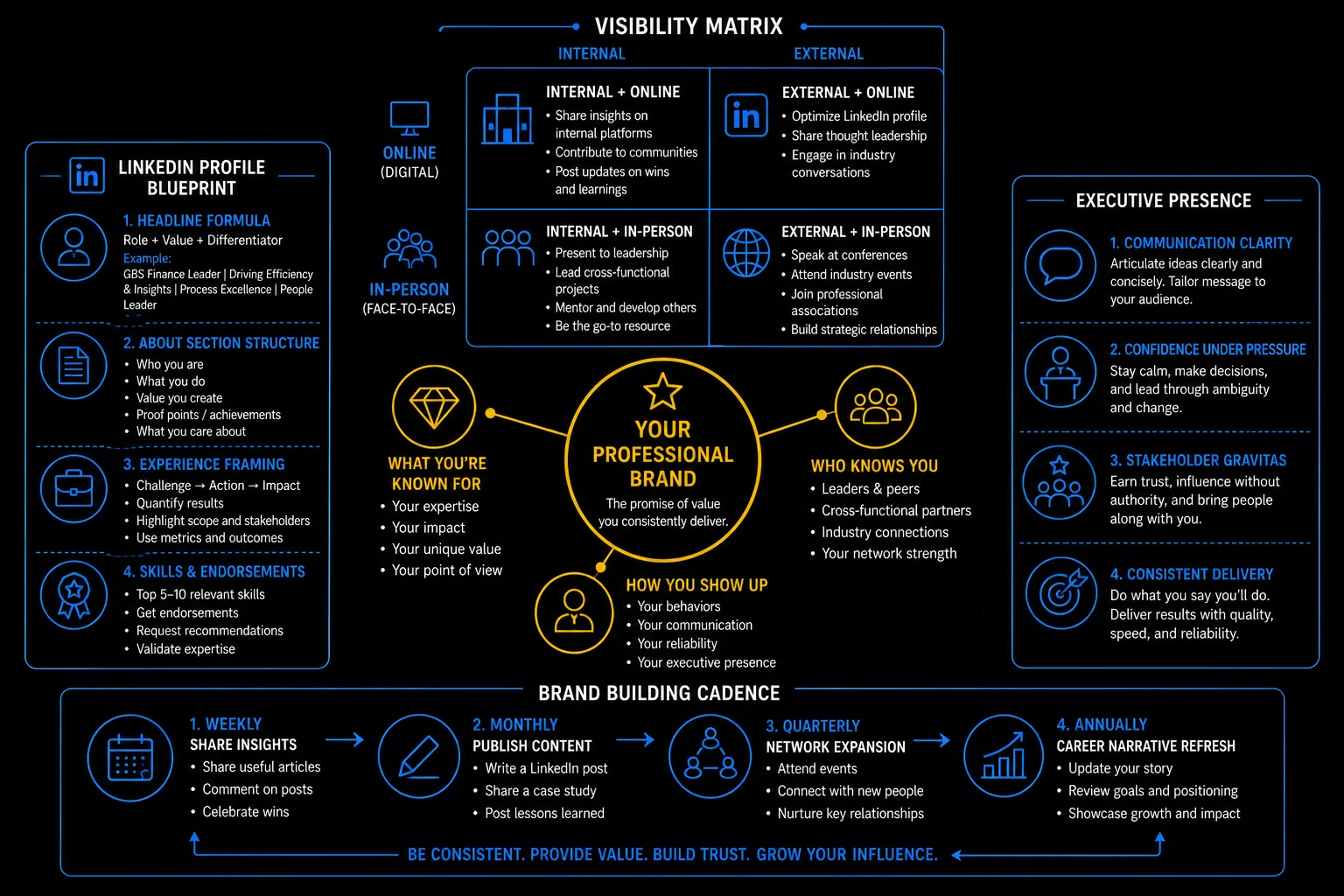
Personal branding system: be consistent, provide value, build trust, grow your influence
Topic 02 · Organizational Visibility
Building an internal reputation
Sponsorship beats mentorship — mentors advise you, sponsors put your name forward in rooms you never enter. Read how to solve this in the section below!
The room decides your career.
You are not in the room.
 R
RA stretch assignment gets discussed two levels up. Ravi is not there. Nobody who knows his work is.
The assignment goes to someone whose name came up — put forward by a director she had helped twice.
Not favoritism. Sponsorship.
"Someone in that room has to say your name. Who says yours?"
He feels sobered by the question.
You have mentors who give advice. What you need is a sponsor — someone senior who puts their own reputation on the line to recommend you when you are not in the room.
Reputation converts through sponsors — and sponsors are earned, not assigned.
Ravi’s intake fix helps a director’s pet metric. Two months later, his name comes up in a room he has never entered.
Internal reputation and sponsorship in depth
Sponsorship beats mentorship for career acceleration. Mentors give advice. Sponsors put your name forward when opportunities arise — and you are not in the room.
What it provides
- Advice and guidance
- Career perspective and coaching
- Network introduction
- Available at any career stage
What it provides
- Advocacy in decision-making rooms
- Active promotion for roles and projects
- Political capital invested in your advancement
- Requires demonstrated performance as prerequisite
- Deliver consistently above expectations — sponsors risk their reputation when they advocate for you
- Be visible to senior leaders — volunteer for presentations, steering committees, and high-profile projects
- Solve problems proactively — sponsors want to endorse people who make things better without being asked
- State your ambitions clearly — a potential sponsor cannot advocate for you if they do not know what you want
- Follow through — nothing kills sponsorship faster than a dropped ball after someone put your name forward
Name your sponsor. Cannot? Pick the problem you will visibly solve for someone senior.
Known inside. Now compress it into one sentence.
Topic 03 · Value Proposition
Personal value proposition design
Your UVP answers in one line what you bring that nobody else on the team brings. Every career surface reuses it. Read how to solve this in the section below!
"What do you do?"
You have ten seconds.
 A
AA director visits the floor. "And what do you do here?"
Amara’s colleague: "I process O2C transactions, mostly disputes, some reporting..."
Amara: "I find why billing errors keep happening — and shut the pattern down."
The director asks Amara a follow-up question. Only Amara.
"One of us described tasks. One of us described value."
She feels memorable — measurably.
You describe your task list when asked about your value.
A UVP is one engineered sentence.
The same sentence powers her intro, her LinkedIn summary, and her review opener. One line, engineered once, reused everywhere.
Personal value proposition in depth
What do you bring that nobody else on the team brings? Your UVP answers this question in one sentence.
A personal value proposition (UVP) is the intersection of three things: what you are excellent at, what your organization needs, and what differentiates you from others with similar titles.
- It is not a generic statement about being a team player or a hard worker.
- It is a specific, provable claim about the unique value you create.
- "I reduce month-end close cycle time by redesigning manual processes into automated workflows" is a UVP. "I am a dedicated finance professional" is not.
- I help [who] achieve [what outcome] by [how I do it differently]
- Example: "I help GBS finance teams reduce close cycle time by identifying and automating the manual bottlenecks that everybody else works around"
- Example: "I help transformation programs land successfully by bridging the gap between project teams that design solutions and operations teams that have to live with them"
- Example: "I help GBS leadership make better decisions by translating complex operational data into clear, actionable executive dashboards"
Personal brand framework — what you stand for
Write your one line: the problem you solve and how. Say it out loud until it fits in ten seconds.
One sentence for the hallway. A stage for the rest.
Topic 04 · Visibility
Public speaking and thought leadership
Speaking and writing position you as an expert, not just an operator. Start smaller than a conference — start with a town hall. Read how to solve this in the section below!
Operators do the work.
Experts get asked about it.
 P
PA town hall needs a five-minute slot on the transition lessons. Nobody volunteers.
Peter takes it. Sweaty hands, three slides, one honest story about what went wrong.
Two directors reference his talk in the following weeks. One asks him to repeat it for another site.
"Five minutes on a stage did what two years at a desk could not."
He feels visible at a new altitude.
You wait until you feel like an expert. The stage is what makes you one.
Thought leadership scales like a staircase — and step one is tiny.
His five-minute talk becomes a repeatable asset — requested, refined, and attached to his name.
Public speaking and thought leadership in depth
Speaking at conferences, writing articles, and contributing to industry discussions positions you as an expert — not just a practitioner.
- Start internally — present at team meetings, town halls, and internal conferences before external events
- Write about what you know — LinkedIn articles on lessons learned from real projects have more credibility than theoretical pieces
- Apply to speak at industry events — SSON, ACCA, and GBS conferences actively seek practitioner speakers
- Build a topic focus — be known for one thing (automation in finance, GBS transitions, process excellence) not everything
- Share failures and lessons — practitioners who share what went wrong and what they learned are more credible than those who only share successes
Claim one internal five-minute slot this quarter. One story, one lesson, three slides.
Pillar 5 complete. Your name carries weight — Pillar 6: make sure your pay does too.
- Your personal brand exists whether you manage it or not. Every email you send, every meeting you attend, every deliverable you produce — people are forming an impression. The question is whether that impression is the one you intended.
- LinkedIn is not optional for GBS professionals anymore. Recruiters, stakeholders, and future managers will look you up. A headline that says "Associate at [Company]" tells them nothing. A headline that says "GBS Process Analyst specializing in P2P automation" tells them everything.
Reference
Glossary
Full glossary at the GBS Insider Club Field Guide.
- LinkedIn — Economic Graph data on professional visibility, 2025
- Harvard Business Review — The Sponsor Effect, 2019
- Hewlett, Sylvia Ann — Forget a Mentor, Find a Sponsor, Harvard Business Review Press, 2013
- SSON — GBS industry conference speaker guidelines, 2025
Knowing the frameworks is the entry ticket. Applying them — visibly, at your actual job — is what gets you promoted.
The GBS Insider Club Career Playbooks turn this theory into a guided 90-day program for your role: self-assessment, practical exercises, templates, and Julian's unfiltered practitioner playbook.
Explore the Career Playbooks → Back to Career and Performance