Pillar 6 · Cluster 1
Understanding your total compensation package
Your salary is not your compensation. Benefits, bonuses, equity, and non-monetary perks make up a total rewards package that varies significantly across GBS hubs. Knowing how to read it gives you negotiation power.
Sound familiar?
Topic 01 · Total Rewards
Cash vs benefits — reading the total package
Two offers with the same base salary can differ by 30% in total value. Read the whole package: benefits, retirement, leave, extras. Read how to solve this in the section below!
The higher salary
paid less overall.
 R
RTwo offers on Ravi’s table. Offer A: higher base. Offer B: lower base.
Then he builds the full table: retirement match, health cover, meal allowance, leave days, bonus target.
Offer B wins by a clear margin — every year, compounding.
"I almost chose a number instead of a package."
He feels relieved he counted first.
You compare base salaries because they are the biggest visible number. The package is the real number.
Total rewards is a four-line sum, not one figure.
His comparison sheet becomes a template — every future offer gets the four-line treatment.
Cash vs benefits in depth — reading the total package
Two offers with the same base salary can differ by 30% in total value when you account for benefits, retirement contributions, insurance, and perks.
- Base salary — fixed cash compensation, the foundation of your package
- Variable pay — bonuses, incentives, and performance-based payouts (typically 5-30% of base for GBS roles)
- Benefits — health insurance, life insurance, disability coverage, dental, vision, wellness programs
- Retirement — pension contributions, 401(k) matching (US), provident fund (India), employer pension schemes (EU)
- Leave — paid time off, sick leave, parental leave, sabbaticals — monetary value varies significantly by country
- Perks — remote work allowance, learning budgets, gym memberships, meal subsidies, transport allowances
- Equity — stock options, RSUs, ESPP for senior GBS roles at publicly traded companies
Comparing base salaries across GBS hubs without considering total rewards is misleading.
- A lower base in Germany with 30 days leave, full healthcare, and employer pension contributions may be worth more than a higher base in a market with fewer mandated benefits
- Always compare total cost to the employer, not just the number on your payslip
Illustrative pay bands — analyst to director (India, 2026)
Build the four-line sum for your current package. Most people cannot state their own total.
The package has a variable line. Learn its rules before it surprises you.
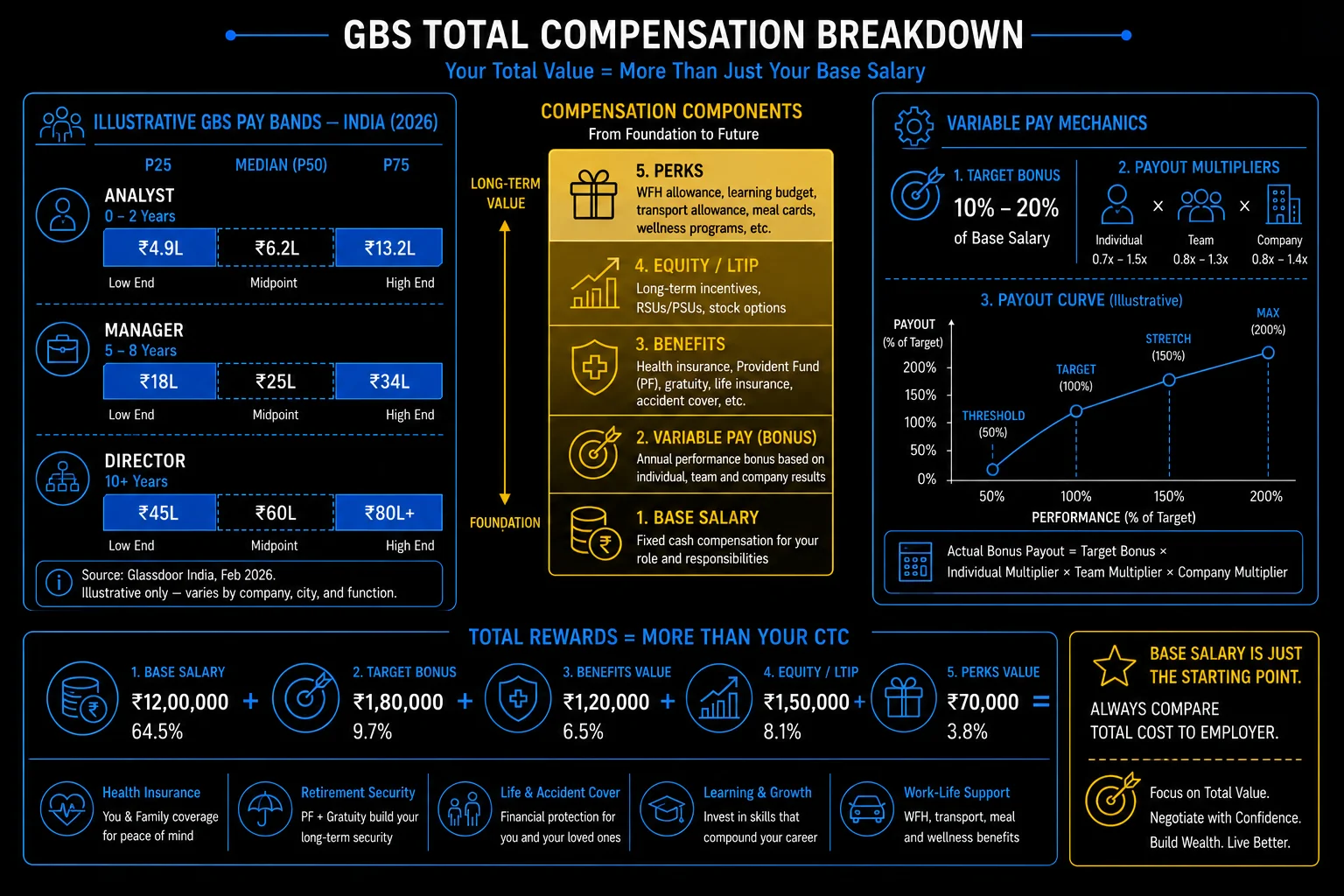
GBS total compensation breakdown — illustrative India 2026 pay bands (source: Glassdoor). Varies by company, city, and function.
Topic 02 · Incentive Structures
Variable pay — bonus structures and STI/LTI
Understanding how your bonus is calculated gives you influence over it. Most people discover the formula after the payout. Read how to solve this in the section below!
Your bonus has a formula.
Have you ever read it?
 K
KBonus day. Klaudia’s payout is lower than expected. She asks why.
The answer was always in the plan document: 10% target, weighted by company multiplier, function score, individual rating.
Two of the three levers were public all year. She watched none of them.
"I could have followed this like a scoreboard. Instead it was a lottery ticket."
She feels determined to read the rules she plays under.
You treat the bonus as random — good year, bad year, nothing you can do. In reality, it is a formula: company result times team result times personal result. At least one of those factors is something you directly influence.
Most GBS plans reduce to three multipliers.
She reads the plan in January, not December. The payout stops being a surprise — twice now.
Variable pay in depth — STI, LTI, and plan mechanics
Understanding how your bonus is calculated gives you power to influence the outcome. If you do not know the formula, you cannot improve for it.
- Short-Term Incentive (STI) — annual or quarterly bonus based on individual and team performance, typically 10-20% of base for mid-level GBS roles
- Long-Term Incentive (LTI) — multi-year awards designed for retention, typically equity-based (RSUs, stock options) for senior roles
- GBS-specific metrics — bonus targets often tied to SLA achievement, cost savings delivered, transformation milestones, and customer satisfaction scores
- Multiplier effect — company performance multiplier (0.8x to 1.2x) applied to individual bonus target means your payout depends on both personal and organizational results
Variable pay — target bonus, multipliers, payout curve
Find your bonus plan document and read the formula. Note which multiplier you can influence.
Cash and bonus mapped. Leadership offers add a third currency.
Topic 03 · Equity Compensation
Equity 101 — stock options and RSUs
Equity compensation is increasingly common in GBS leadership roles. Know the vesting schedule, the type, and the tax moment. Read how to solve this in the section below!
Shares in your offer.
Worth everything or nothing — read the schedule.
 P
PPriya’s new offer includes RSUs. Her first reaction: free money.
Then she reads: four-year vesting, one-year cliff, taxed at vest, forfeited on exit before each date.
The "free money" is a retention contract with a calendar.
"The grant is a promise. The vesting schedule is the truth."
She feels clear-headed about what she actually signed.
You value the grant at face value and ignore the calendar that controls it.
Three facts decode any equity offer — type, schedule, tax moment.
Her career timeline and vesting calendar now live on the same page. Decisions account for both.
Equity 101 in depth — RSUs and options
Equity compensation is increasingly common for GBS leadership roles. Understanding the basics prevents you from leaving value on the table.
How they work
- Right to buy shares at a fixed price (strike price)
- Value only if stock price rises above strike price
- Exercise window — typically 10 years
- Complex tax treatment — taxed at exercise and/or sale
How they work
- Promise to receive actual shares after vesting period
- Have value as long as the stock has any value
- Vest over time (typically 4 years with 1-year cliff)
- Simpler tax treatment — taxed as income at vesting
- Vesting schedule matters — a $100K equity grant that vests over 4 years is worth $25K per year, not $100K today
- Tax implications vary by country — consult a tax advisor before exercising options or selling vested shares
- Equity is illiquid until vested and sold — do not count unvested equity as available compensation
- Golden handcuffs — large unvested equity can make leaving expensive, which is exactly the retention purpose
Total rewards — base salary is just the starting point
If you hold equity: write down your next vest date and its tax treatment. If not, learn RSU vs option now — before the offer that includes them.
You can read your own package. Cluster 2: now read the market around it.
Understanding how compensation works gives you real leverage. Know the system, and you'll work it smarter.
- Job bands create structure, but exceptions happen, especially if you know the system.
- Your two highest-leverage salary moments are when they hire you and when you move into an internal new role. Everything in between is incremental, so make those moments count.
- Market dynamics matter too: high demand for your expertise means stronger negotiating power. On applications, make sure your expected salary aligns with the band, because ATS scanners screen for this before a human ever sees your CV.
- If base salary is rigid, negotiate the edges: gym membership, language courses, relocation support, training budget. Most managers have more flexibility on benefits than on base pay.
Reference
Glossary
Full glossary at the GBS Insider Club Field Guide.
- WorldatWork — Total Rewards Model and framework, 2024
- Mercer — Global Compensation Planning Survey, 2025
- Willis Towers Watson — Benefits Trends Survey, 2025
- SHRM — Employee Benefits Survey, 2025
Test Yourself
Scenario check — would you make the right call?
No trivia. Every question is a situation you will actually face. Pick your answer, get the reasoning.
Knowing the frameworks is the entry ticket. Applying them — visibly, at your actual job — is what gets you promoted.
The GBS Insider Club Career Playbooks turn this theory into a guided 90-day program for your role: self-assessment, practical exercises, templates, and Julian's unfiltered practitioner playbook.
Explore the Career Playbooks → Back to Total Rewards