Pillar 6 · Cluster 3
Global mobility and cross-border compliance
International assignments, cross-border remote work, and hub relocations create tax, social security, and compliance obligations that most GBS professionals do not understand until they encounter them.
Sound familiar?
Topic 01 · Global Mobility
Expat packages and relocation — what is covered
International assignments come with structured packages designed to make the move cost-neutral. Know the components before you sign. Read how to solve this in the section below!
The assignment abroad
is a package, not a salary.
 P
PA two-year assignment offer lands on Priya’s desk. Singapore.
The salary line looks modest — until she reads the rest: housing allowance, schooling, COLA, flights home, tax equalization.
The package doubles the picture. And two items she expected are missing.
"The salary is one line of nine. Negotiate the other eight."
She feels prepared walking into the conversation.
You evaluate an international offer on the salary line and sign away the eight lines around it.
Expat packages are built from standard components — all of them negotiable.
She negotiates the two missing components before signing. The assignment starts cost-neutral, as designed.
Expat packages in depth — full component list
International assignments come with compensation structures designed to make the move cost-neutral for the employee. Understanding the components prevents surprises.
- Cost of Living Adjustment (COLA) — differential payment to maintain purchasing power in a higher-cost location
- Housing allowance — either company-provided housing or a fixed allowance based on local market rates
- Tax equalization — the company covers the difference between home and host country tax obligations so the employee pays no more than they would at home
- Relocation support — moving expenses, temporary accommodation, visa and immigration fees, orientation trips
- Hardship allowance — additional payment for assignments in locations with challenging living conditions
- Education allowance — tuition fees for dependent children, particularly for international school enrollment
- Home leave — annual flights to home country for the employee and family
Assignment types — short-term, long-term, permanent, commuter
Mobility package — relocation, housing, COLA, schooling, flights
If mobility is on your horizon: list the nine package components now. Know them before an offer exists.
Crossing borders moves money — and creates obligations nobody mentions.
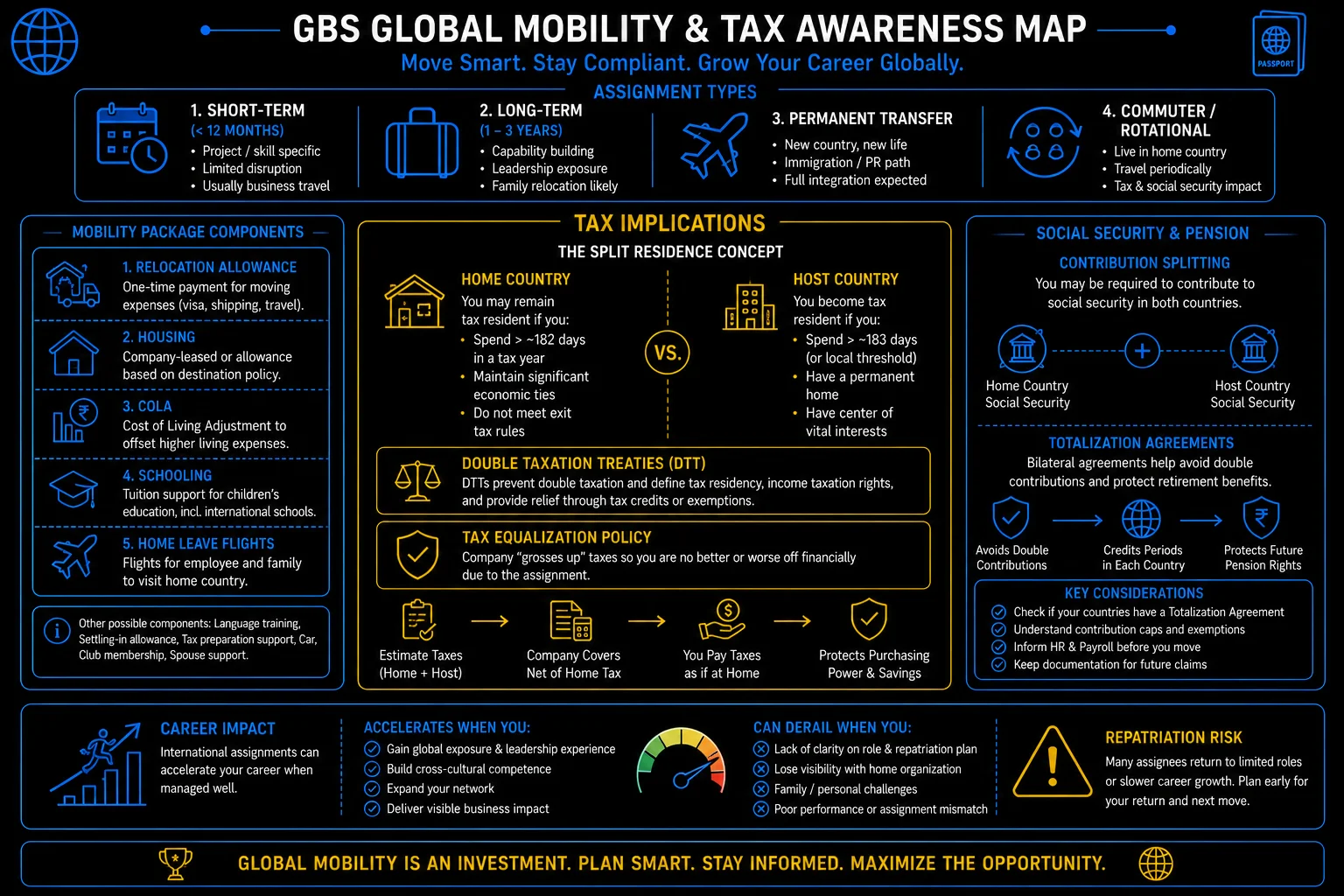
GBS global mobility & tax awareness: move smart, stay compliant, grow your career globally
Topic 02 · Tax Compliance
Cross-border work — tax and compliance implications
Working from another country — even briefly — can create tax obligations and compliance risk. Days count; track them. Read how to solve this in the section below!
Three weeks working abroad.
Two tax authorities noticed.
 P
PPeter spends a summer working remotely from his family’s place across the border. Nobody minds.
Year-end: a questionnaire from payroll. Days worked per country. Thresholds. A second filing obligation he never knew existed.
"I thought I took my laptop on holiday. The tax code thought I relocated."
He feels wiser — one paperwork season later.
You treat workation days as vacation. Tax residency rules count them differently.
Cross-border work triggers on counted days — three rules cover most cases.
His next workation request goes through the policy first. Ten days, approved, zero surprises in April.
Cross-border tax and compliance in depth
Working from a different country for even a few days can create tax obligations, permanent establishment risks, and social security complications. This is not theoretical — it is a growing compliance challenge.
- Tax residency triggers — spending more than 183 days in many countries creates tax obligations; some countries have lower thresholds
- Permanent establishment risk — an employee working from a country for extended periods can create a taxable presence for the employer, triggering corporate tax obligations
- Social security conflicts — working in one country while being paid by an entity in another can create dual social security obligations unless treaty provisions apply
- Payroll compliance — employer may need to register for payroll tax in the country where the employee is working
- Immigration risk — working on a tourist visa or without proper work authorization creates legal liability for both employee and employer
The pandemic normalized cross-border remote work, but the tax and compliance frameworks have not kept up.
- Many GBS professionals work remotely from countries other than their employment contract location without realizing they may be creating tax and legal obligations for themselves and their employer.
- If you work remotely from another country for more than a few weeks, check with your HR and tax teams before assuming it is fine.
Tax implications — split residence, DTT, tax equalization
Find your company’s work-from-abroad policy. Know the day limit before you book anything.
Pillar 6 complete — you can read every line of your rewards. Pillar 7: leading the people around you.
- International assignments are career accelerators, but only if you negotiate the package properly upfront. I have seen people accept moves without tax equalization and end up paying double tax for two years. Ask for the full policy document before you sign anything.
- The unspoken reality of global mobility: the assignment changes your career trajectory, but repatriation is where most people struggle. Plan your return before you leave — who will sponsor your landing role, what comes next, how do you leverage the international experience.
Reference
Glossary
Full glossary at the GBS Insider Club Field Guide.
- OECD — Model Tax Convention on Income and Capital, Article 15
- EY — Global Mobility Effectiveness Survey, 2025
- KPMG — Global Assignment Policies and Practices Survey, 2024
- Deloitte — Cross-border remote work tax guide, 2025
Knowing the frameworks is the entry ticket. Applying them — visibly, at your actual job — is what gets you promoted.
The GBS Insider Club Career Playbooks turn this theory into a guided 90-day program for your role: self-assessment, practical exercises, templates, and Julian's unfiltered practitioner playbook.
Explore the Career Playbooks → Back to Total Rewards