Pillar 7 · Cluster 3
Performance management that actually works
Coaching, managing underperformance, and calibrating ratings fairly are the hardest parts of people management. Getting them right determines team morale, retention, and output quality.
Sound familiar?
Topic 01 · Leadership Style
Coaching vs managing — the distinction
Managing tells people what to do. Coaching helps them figure it out. Both are necessary — the skill is choosing the right one per moment. Read how to solve this in the section below!
Every answer you give
is a question they stop asking themselves.
 M
MMiguel’s strongest analyst brings him the same category of problem for the third week running.
Each time, Miguel solved it in two minutes. Efficient — and the reason she keeps coming back.
This time he asks instead: "What have you tried? What would you do if I were on leave?"
"She had the answer. She had never been required to use it."
He feels patient in a way that finally pays.
Answering fast feels like good leadership. It quietly trains the team to stop thinking.
Two modes, one selector.
Week four: the analyst solves the problem alone and mentions it in the huddle. The two minutes he stopped spending bought her independence.
Coaching vs managing in depth
Managing tells people what to do. Coaching helps people figure out what to do. Both are necessary — the skill is knowing when to use each.
When to use
- New employees still learning the basics
- Crisis situations requiring immediate action
- Compliance-critical processes with zero tolerance for deviation
- Time-critical deliverables with no room for exploration
When to use
- Experienced team members who need guidance, not instruction
- Development conversations focused on growth and capability
- Problem-solving where the individual needs to build judgment
- Career discussions where the employee should own the direction
9-box grid — high performer vs high potential
Next repeat question, answer with a question: "What would you try?" Hold the silence that follows.
Coaching grows the strong. Structure carries the struggling.
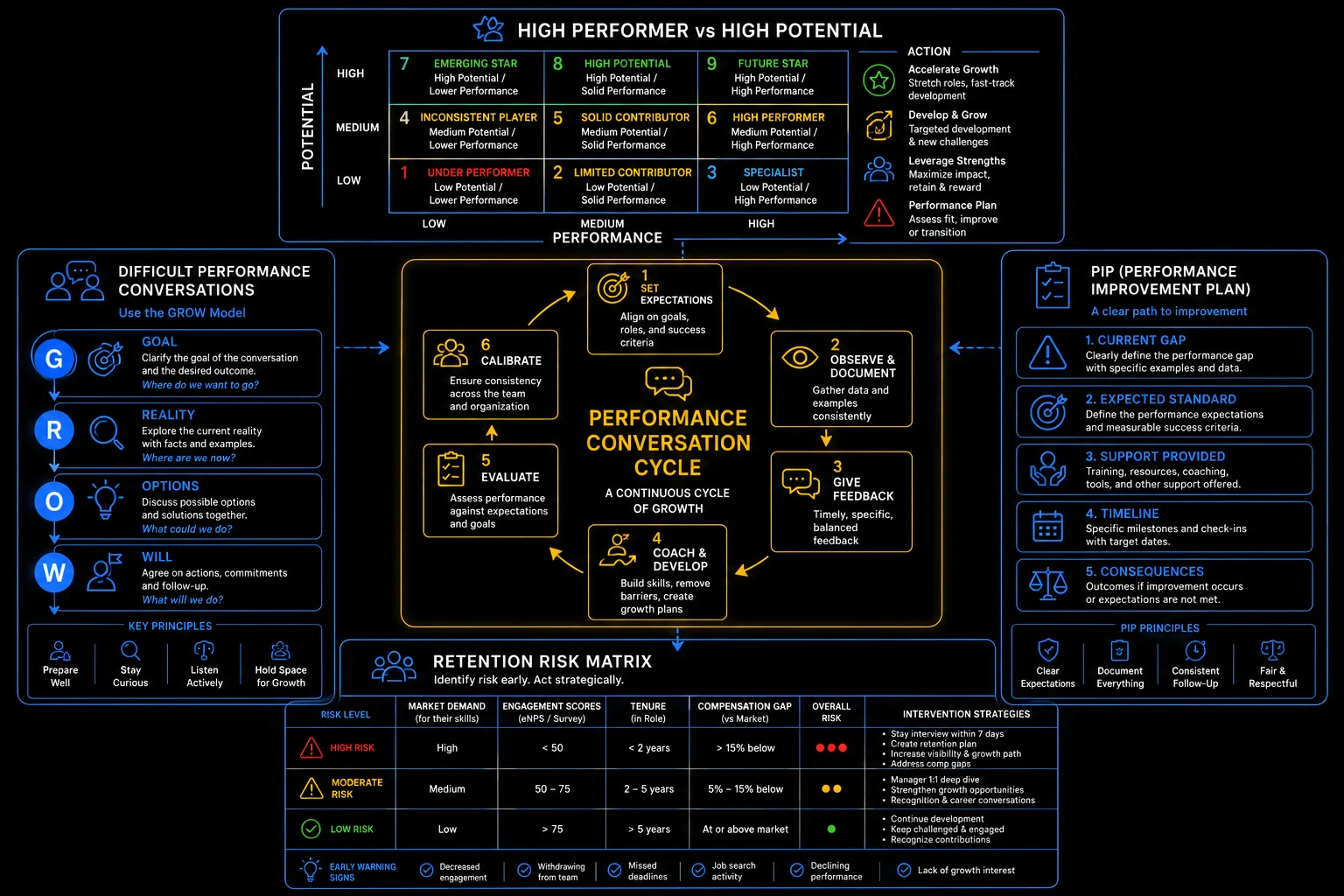
Manager's performance management toolkit: 9-box grid, conversation cycle, GROW model, and retention risk matrix
Topic 02 · Underperformance
The PIP process — managing low performers
A PIP done well is a structured path to genuine recovery or a clear, fair, documented outcome. Fair process is the whole point. Read how to solve this in the section below!
The hardest process you will run.
Fairness is what makes it bearable.
 P
PPeter’s first PIP. Sustained underperformance, months of informal feedback, no change.
He dreads it as a punishment ritual. HR reframes it: specific targets, real support, honest checkpoints, sixty days.
The team member later says the strangest thing:
"This is the first time anyone told me exactly what good looks like."
He feels conflicted — and does it properly anyway.
You avoid the formal process to be kind — and deliver years of ambiguity instead, which is crueler.
A fair PIP has three non-negotiables.
Day sixty arrives with evidence, not opinions — whichever way it goes, everyone involved calls it fair.
The PIP process in depth
A Performance Improvement Plan is not a termination document. Done well, it is a structured path to either genuine recovery or a clear, documented decision.
Exhaust informal interventions first
Before a formal PIP, ensure the employee has received clear feedback, specific examples, and reasonable time to adjust. Document these conversations.
Define measurable improvement targets
Vague targets like "improve quality" are unfair and unenforceable. Specify exact metrics, thresholds, and the timeline for measurement.
Provide support resources
A PIP without support is a setup for failure. Offer training, mentoring, adjusted workload, or additional check-ins to give the employee a real chance to succeed.
Review at defined milestones
Weekly or bi-weekly reviews against PIP criteria. Document progress honestly — both improvements and continued gaps.
Make the decision transparently
At the end of the PIP period, the outcome should be clear to everyone — successful completion and exit from PIP, extension with modified targets, or separation.
PIP — current gap, expected standard, support, timeline, consequences
If informal feedback has repeated three times without change: talk to HR about structure this week.
Fair with one person. Calibration is fairness across all of them.
Topic 03 · Rating Fairness
Calibration sessions — ensuring fairness
Without calibration, ratings reflect manager generosity more than performance. In the room, documented evidence wins. Read how to solve this in the section below!
Your generous rating
just cost someone else’s bonus.
MMiguel’s first calibration. He rates his whole team high — they worked hard, and he wants to reward them.
Then he watches the room: every inflated rating from one manager pushes a deserving person from another team down the curve.
The managers with evidence — numbers, examples, stakeholder quotes — hold their ratings. The generous ones lose theirs.
"The room does not argue with feelings. It argues with files."
He feels schooled — and starts a evidence folder that afternoon.
You inflate ratings to be kind and walk into calibration with adjectives against other managers’ evidence.
Calibration is won before the meeting.
Next cycle: his ratings hold in the room — because every one of them arrives with receipts.
Calibration sessions in depth
Without calibration, ratings reflect manager generosity more than employee performance. Calibration forces managers to defend their ratings against a consistent standard.
- Managers present their proposed ratings for each team member to a peer group of managers at the same level
- Each rating must be supported by specific evidence — achievements, metrics, and behavioral examples
- The group challenges outliers — unusually high or low ratings require stronger justification
- Distribution guidance (not forced ranking) ensures that ratings reflect relative performance, not absolute grading
- HR runs to prevent dominant personalities from steering outcomes and to ensure consistent application of criteria
Calibration protects fairness, but it also rewards whoever advocates best. Come prepared.
- Calibration prevents rating inflation and ensures fairness across teams. It also creates political dynamics.
- Managers who advocate more effectively for their team members can secure better outcomes.
- The best protection for your team is documentation. Come to calibration with specific, quantified evidence that makes your case undeniable.
GROW model — goal, reality, options, will
Start the evidence file per team member today. One win with a number, per person, per month.
People assessed fairly. Cluster 4: now think like the level above.
- A PIP should never be a surprise. If someone lands on a performance improvement plan and did not see it coming, the manager failed — not the employee. Feedback should have been flowing for months before the formal process starts.
- The 9-box grid is a useful framework, but treat it as a conversation starter, not a verdict. People move boxes based on context, projects, and life circumstances. A "core player" in the wrong role might be a "star" in the right one. As a manager, your job is to find that fit.
- Coaching is the highest-leverage activity a manager can do — and the one most managers skip because it feels slow. One great coaching conversation that helps someone solve their own problem builds more capability than ten directive emails telling them what to do.
Reference
Glossary
Full glossary at the GBS Insider Club Field Guide.
- Harvard Business Review — The Performance Management Revolution, 2016
- McKinsey — Performance management that drives results, 2024
- CIPD — Managing Underperformance Guide, 2024
- Gallup — Strengths-based performance development, 2025
Knowing the frameworks is the entry ticket. Applying them — visibly, at your actual job — is what gets you promoted.
The GBS Insider Club Career Playbooks turn this theory into a guided 90-day program for your role: self-assessment, practical exercises, templates, and Julian's unfiltered practitioner playbook.
Explore the Career Playbooks → Back to Leadership and People