Pillar 7 · Cluster 4
Strategic leadership for GBS managers
Budgets, P&L understanding, org design, and psychological safety are the strategic capabilities that separate operational managers from GBS leaders who shape the organization.
Sound familiar?
Topic 01 · Financial Management
Budgeting — Capex, Opex, and headcount planning
If you manage a team, you own or influence a budget. Capex vs Opex, honest FTE costing, and a defendable buffer are the entry skills. Read how to solve this in the section below!
Your first budget
is a credibility test in disguise.
 P
PPeter’s first budget round. He submits headcount salaries and calls it done.
Finance returns it with questions: fully loaded FTE cost? License growth? Training? Attrition buffer?
His number was 30% light — every gap a future emergency.
"A budget is what the whole year will ask for — salaries are just the visible part."
He feels corrected — once, thoroughly.
You budget salaries and discover the other 30% of costs as mid-year surprises.
A defendable budget covers three layers.
His resubmission survives review without a single follow-up question. Finance remembers who does the homework.
Budgeting in depth — Capex, Opex, FTE costing
If you manage a team, you either own a budget or influence one. Understanding Capex vs Opex, FTE costing, and budget defense is not optional for managers who want to lead.
- Opex (Operating Expenditure) — recurring costs: salaries, software licenses, travel, training. This is your annual run-rate budget.
- Capex (Capital Expenditure) — one-time investments: system implementations, infrastructure, major tool purchases. Amortized over useful life on the balance sheet.
- FTE costing — fully loaded cost per employee includes salary, benefits, taxes, overhead allocation, and facilities. Typically 1.3-1.7x base salary.
- Budget defense — justify every line item with business impact. "We need this" is not a business case. "This investment reduces processing cost by $200K annually" is.
- Variance management — track actuals vs budget monthly. Explain variances before someone asks you to.
Vision to execution — strategy, objectives, initiatives, KPIs, daily work
Ask Finance for your team’s fully loaded FTE cost. Compare it to the salary number in your head.
Your budget is one line of a bigger sheet. Learn to read the sheet.
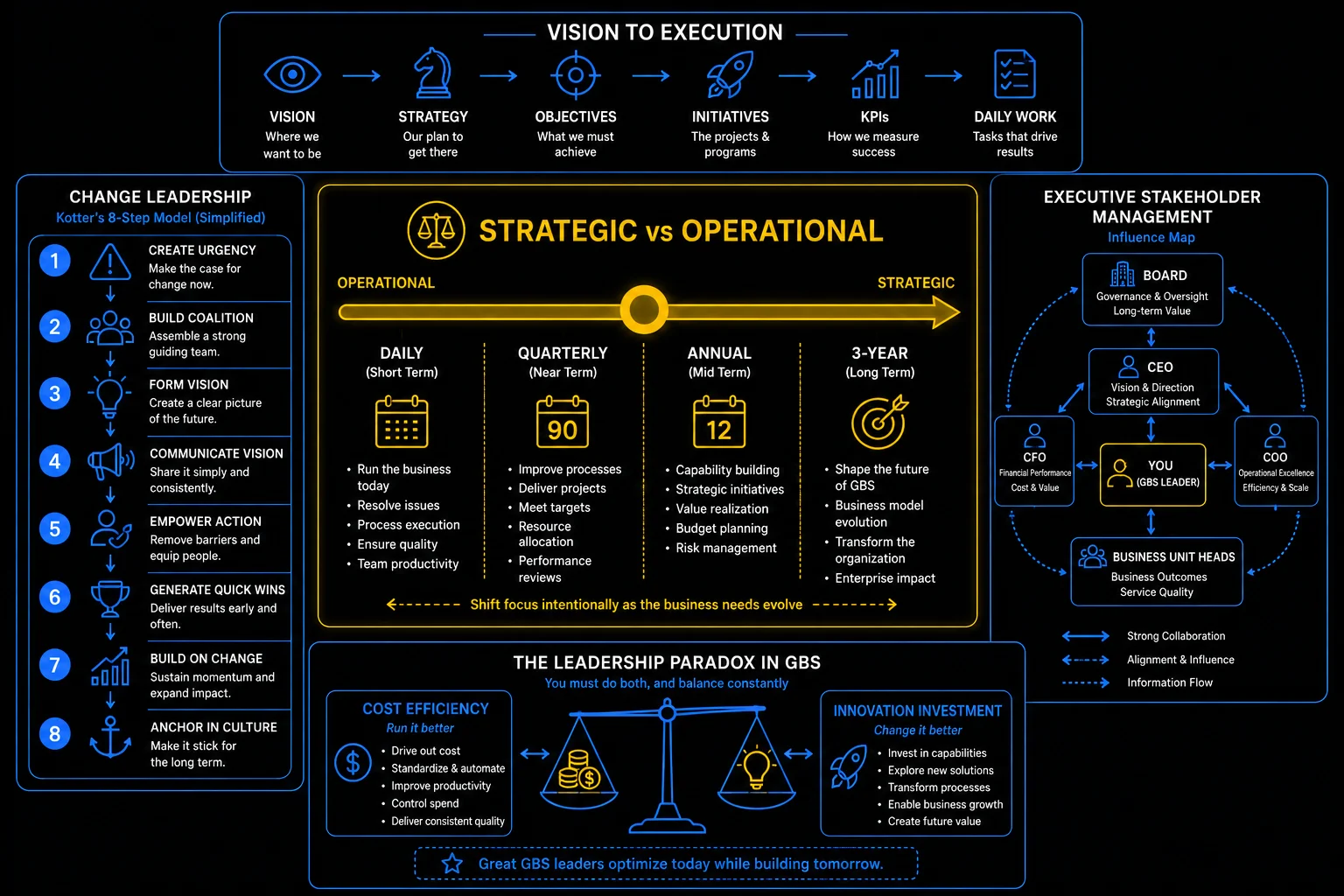
GBS strategic leadership: great leaders optimize today while building tomorrow
Topic 02 · Financial Literacy
Understanding the P&L for non-finance managers
You need to know where your team appears on the income statement and how your daily decisions move it — not accounting mastery. Read how to solve this in the section below!
Your team lives on a line
you have never read.
 M
MA cost review names Miguel’s team. He realizes he cannot say where they sit on the P&L or what moves their line.
One coffee with a Finance colleague fixes it: his team is Opex inside SG&A; overtime, licenses, and error-driven rework are the levers he actually controls.
"I manage a P&L line. I just never knew its name."
He feels grounded in a language the review speaks.
You manage operationally and go silent the moment the conversation turns financial.
P&L literacy for a team lead is three questions.
At the next cost review, Miguel speaks in the sheet’s language. The conversation about his team happens with him, not about him.
The P&L for non-finance managers in depth
You do not need to be an accountant. But you need to understand where your team shows up on the income statement and how your operational decisions affect the numbers.
- Revenue line — GBS is typically a cost center, not a revenue generator. Your value shows up as cost reduction, not revenue growth.
- Cost of delivery — your team's fully loaded cost is an operating expense. Every efficiency you create reduces this line.
- SGA (Selling, General and Administrative) — many GBS costs sit here. Understanding the classification matters for how leadership views your function.
- EBITDA impact — your cost savings flow through to EBITDA. When you save $500K in processing costs, that is a direct bottom-line impact.
Book 30 minutes with a Finance colleague: "Show me my team’s line." Ask what moves it.
One team is a line. Many teams are a shape.
Topic 03 · Organization Structure
Org design — span of control and layering
Too many layers slow decisions; too few overwhelm managers. Span and layering are readable signals of organizational maturity. Read how to solve this in the section below!
The org chart is a message.
Learn to read it.
PPeter compares two functions. One: five layers between analyst and director, decisions take weeks.
The other: leads with fourteen direct reports each, drowning, coaching nobody.
Both charts looked reasonable in isolation. Both are failing differently.
"One org cannot decide. The other cannot develop. The chart predicted both."
He feels perceptive — org charts stopped being wallpaper.
You accept the structure as given instead of reading what it does to speed and people.
Two dials, one balance.
His restructure proposal names the trade-off explicitly — and reads like it came from one level up.
Org design in depth — span and layering
Too many layers slow decisions. Too few create overwhelmed managers. Org design in GBS is about finding the structure that balances control, speed, and development.
- Span of control — GBS operational team leads typically manage 8-15 direct reports; senior managers manage 5-8
- Layering — every organizational layer adds communication delay and interpretation risk; aim for the fewest layers that maintain control
- Specialist vs generalist teams — process-aligned teams (all AP in one team) vs customer-aligned teams (all services for one BU in one team)
- Hybrid models — combining process specialization for efficiency with customer-facing relationship management for service quality
Kotter's 8-step change model — urgency through anchoring
Count your function’s span and layers. Name which failure mode you are closer to.
Structure sets the stage. Safety decides what people say on it.
Topic 04 · Team Environment
Psychological safety and team resilience
Teams afraid to speak up perform worse on every metric. Psychological safety is built through the leader’s reaction to bad news. Read how to solve this in the section below!
Silent teams
are hiding problems.
 M
MAn analyst tells Miguel about an error — hers — two hours after it happened, in time to fix it cheaply.
He knows teams where that error would surface in a stakeholder escalation three weeks later, wrapped in a cover story.
The difference was built months earlier: every flagged problem met with "thank you," every mistake dissected without blame.
"They tell me early because early is safe here."
He feels rewarded by his own boring consistency.
You say "my door is open" while your reaction to the last bad news taught everyone the real policy.
Safety is built in reaction moments — three habits carry it.
Problems surface at two hours old, not three weeks. On every metric that matters, that is the whole game.
Psychological safety in depth
Teams where people are afraid to speak up, admit mistakes, or challenge ideas perform worse on every metric. Psychological safety enables honest, productive work.
- Model vulnerability — share your own mistakes and learning moments; if the manager never admits error, the team will not either
- Respond to bad news constructively — how you react to problems determines whether people will tell you about them early or hide them
- Separate the person from the idea — critique proposals and decisions, not the people who made them
- Invite dissent explicitly — "What am I missing?" and "Who sees this differently?" create permission to challenge
- Follow through on commitments to the team — broken promises destroy trust faster than any other management behavior
- Google's Project Aristotle found that psychological safety was the single most important factor in team effectiveness — above skill, experience, and resources.
- In GBS, psychological safety directly impacts error reporting. Teams afraid to report mistakes create hidden quality problems that surface as audit findings or customer complaints.
The leadership paradox — cost efficiency vs innovation investment
Next time someone flags a problem: thank them first, in front of others. Diagnose second.
Pillar 7 complete. You can lead a team — Pillar 8: now lead the change.
Reference
Glossary
Full glossary at the GBS Insider Club Field Guide.
- Google — Project Aristotle research on team effectiveness, 2015
- Edmondson, Amy — The Fearless Organization, Wiley, 2018
- McKinsey — Organization design for the future, 2024
- CIMA — Management Accounting for Non-Finance Managers, 2024
Knowing the frameworks is the entry ticket. Applying them — visibly, at your actual job — is what gets you promoted.
The GBS Insider Club Career Playbooks turn this theory into a guided 90-day program for your role: self-assessment, practical exercises, templates, and Julian's unfiltered practitioner playbook.
Explore the Career Playbooks → Back to Leadership and People