Pillar 8 · Cluster 3
Stakeholders and value realization
RACI matrices clarify who does what. Benefits realization tracks whether the project actually delivered value. Steering committees provide governance. Together, they determine project success.
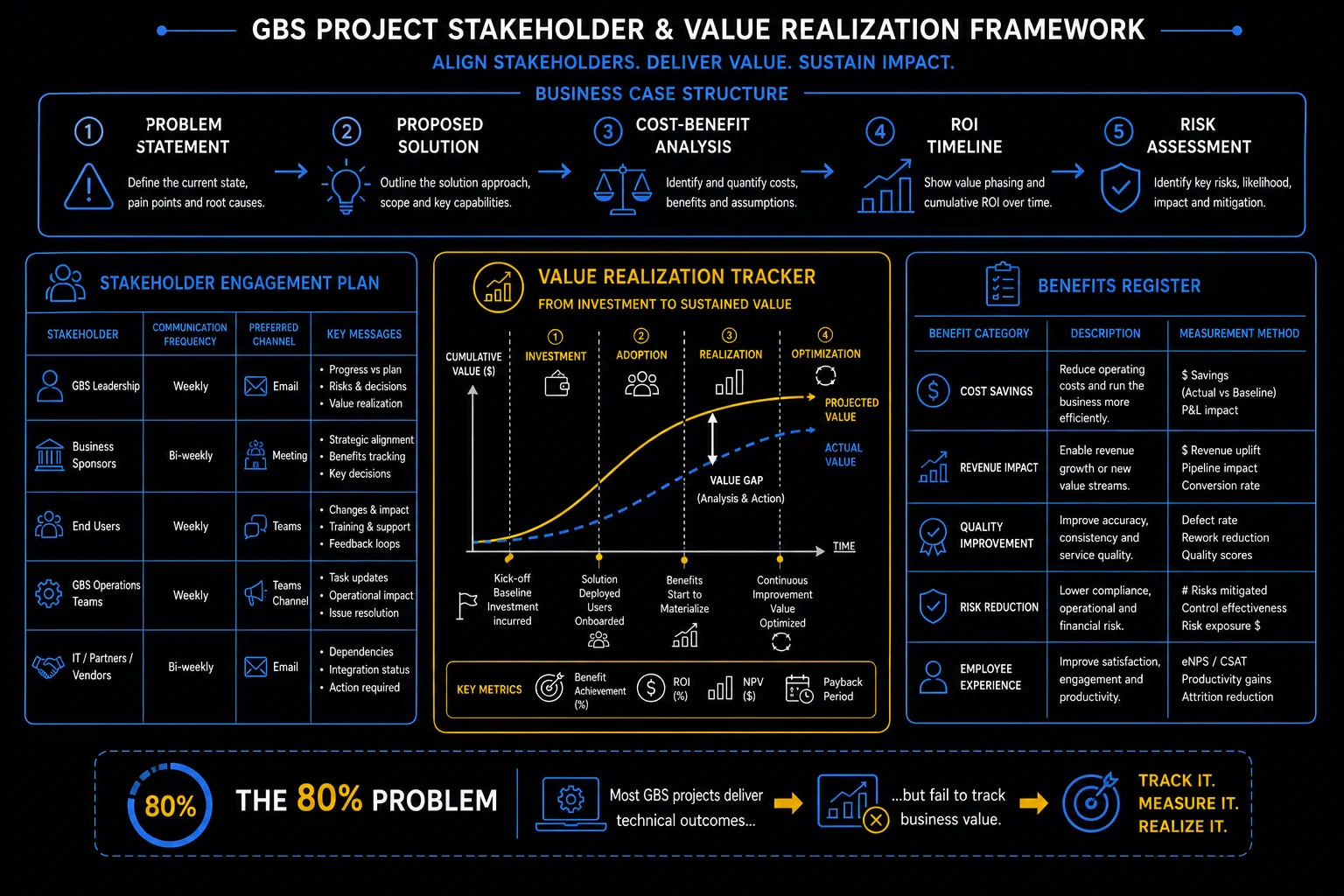
GBS project stakeholder and value realization framework
Sound familiar?
Topic 01 · Role Clarity
RACI matrix — mapping roles and responsibilities
RACI ends the "I thought you had it" failure: one Accountable per task, Responsible doers, Consulted and Informed defined. Read how to solve this in the section below!
Everyone assumed someone.
Someone assumed you.
 K
KThree weeks, two teams, one deliverable — built twice, in two versions, by people who each thought they owned it.
Klaudia draws the grid: who does, who owns, who advises, who just needs to know.
Thirty minutes of clarity ends three weeks of duplication.
"The work was never the problem. The ownership was."
She feels effective with the simplest tool on the project.
You assume ownership is obvious. On cross-team work, obvious means duplicated or dropped.
Four letters, one hard rule.
Every deliverable gets one A. Duplication and dropping both stop — the grid catches what assumption missed.
RACI in depth — with worked example
When everyone is responsible, nobody is responsible. RACI prevents ambiguity by defining exactly who does the work, who owns the outcome, who provides input, and who needs to be kept aware.
- Responsible (R) — the person or team who does the work. There can be multiple Rs for different sub-tasks.
- Accountable (A) — the single person who owns the outcome. Only one A per task. The buck stops here.
- Consulted (C) — people whose input is needed before the work is done. Two-way communication.
- Informed (I) — people who need to know the outcome but do not need to provide input. One-way communication.
The most common RACI failure is having too many Cs and no clear A. Every stakeholder wants to be consulted, which creates a consensus-driven paralysis. A well-governed RACI does three things:
- Assigns exactly one A per deliverable.
- Limits Cs to those whose input genuinely changes the quality of the decision.
- Uses I liberally to keep people informed without slowing down execution.
Business case — problem, solution, cost-benefit, ROI, risk
RACI your most confused deliverable. Enforce the single-A rule.
Roles clear. Now the money the project promised.
Topic 02 · Value Tracking
Benefits realization — tracking ROI post-project
Benefits realization starts at the charter, not at go-live. A benefit without a baseline, owner, and date is a hope. Read how to solve this in the section below!
The project delivered.
Did the benefits?
 P
PSix months after go-live, Finance asks Peter for the promised savings.
The project closed green. The savings were never baselined, never assigned, never tracked.
The number in the business case is now unprovable — in both directions.
"We finished the project and lost the point of it."
He feels cornered by a question the charter should have answered.
You track whether the project delivered on time and on budget. Nobody tracks whether it delivered the business result it promised — the cost reduction, the faster processing, the quality improvement that justified the investment.
Benefits survive on three anchors set at the charter.
His next charter has a baseline table and a benefit owner. Finance signs the savings a year later — with evidence.
Benefits realization in depth
The project business case promises benefits. Benefits realization tracks whether those benefits actually materialized after the project ended.
- Define benefits at project initiation — not after go-live, when it is too late to set baselines
- Baseline current state — measure the metrics you plan to improve before the project begins
- Assign benefit owners — someone accountable for each benefit realization, independent of the project team
- Track at 3, 6, and 12 months post-go-live — benefits rarely materialize at go-live; they emerge as adoption matures
- Report honestly — if benefits did not materialize, document why and adjust future business cases accordingly
Benefits register — cost savings, revenue, quality, risk, experience
For your current project: name the benefit owner. If nobody is, that is the finding.
Benefits need sponsors alive and engaged. Sponsors need managing too.
Topic 03 · Governance
Managing executive sponsors and steering committees
Sponsors and steering committees do not manage themselves. Prepare them, feed them decisions, never surprises. Read how to solve this in the section below!
Your steering committee
steers only if you load the wheel.
 P
PPriya’s first steering meeting: twelve slides of status, polite nods, zero decisions.
A veteran PM shows her the trick: brief the sponsor before the meeting, put one decision on the table, frame options with a recommendation.
Next session: eight minutes of status, one decision taken.
"Steering committees decide what you prepare them to decide."
She feels in control of a room above her pay grade.
You present status updates to the steering committee and wonder why they never make decisions. Steering committees decide what you prepare them to decide — if you present data without a clear question or recommendation, nothing happens.
Steering runs on preparation, not presentation.
Her steering sessions shrink and sharpen. The committee starts doing its actual job — because she does hers.
Sponsors and steering committees in depth
Steering committees are where projects get approved, funded, and protected. Managing them well is the difference between a project with air cover and a project that gets defunded at the first obstacle.
- Pre-wire decisions — never surprise a steering committee; brief key members individually before the meeting
- Focus on decisions, not updates — status reports can be read; steering committee time should be used for decisions and escalations
- Present options, not problems — come with recommended actions and the trade-offs of alternatives
- Protect the sponsor — your executive sponsor's credibility is tied to the project; keep them informed of risks early so they are never blindsided
- Document decisions and distribute immediately — steering committee decisions carry organizational authority only when documented and communicated
Value realization — investment to optimization
Before your next steering: pre-brief the sponsor and frame one decision. Recommendation included.
Governance moves the top. Cluster 4: the humans it lands on.
- I have never seen a project fail because the business case was wrong. I have seen dozens fail because nobody tracked whether the promised benefits were actually delivered. Benefits realization tracking should start at the charter, not at go-live.
- Hard savings hit the P&L. Soft savings make a nice slide. Finance will only validate the hard ones. If your improvement project claims "productivity gains" without showing headcount reduction or volume absorption, expect pushback at sign-off.
Reference
Glossary
Full glossary at the GBS Insider Club Field Guide.
- PMI — Benefits Realization Management Practice Guide, 2019
- PRINCE2 — Project Board and steering committee governance
- McKinsey — The role of the executive sponsor in transformation, 2024
Knowing the frameworks is the entry ticket. Applying them — visibly, at your actual job — is what gets you promoted.
The GBS Insider Club Career Playbooks turn this theory into a guided 90-day program for your role: self-assessment, practical exercises, templates, and Julian's unfiltered practitioner playbook.
Explore the Career Playbooks → Back to Projects and Transformation