Pillar 8 · Cluster 5
SME participation in GBS projects
When operations professionals are pulled into project work as subject matter experts, they face the dual challenge of maintaining BAU performance while contributing to transformation. This section covers how to navigate that tension.
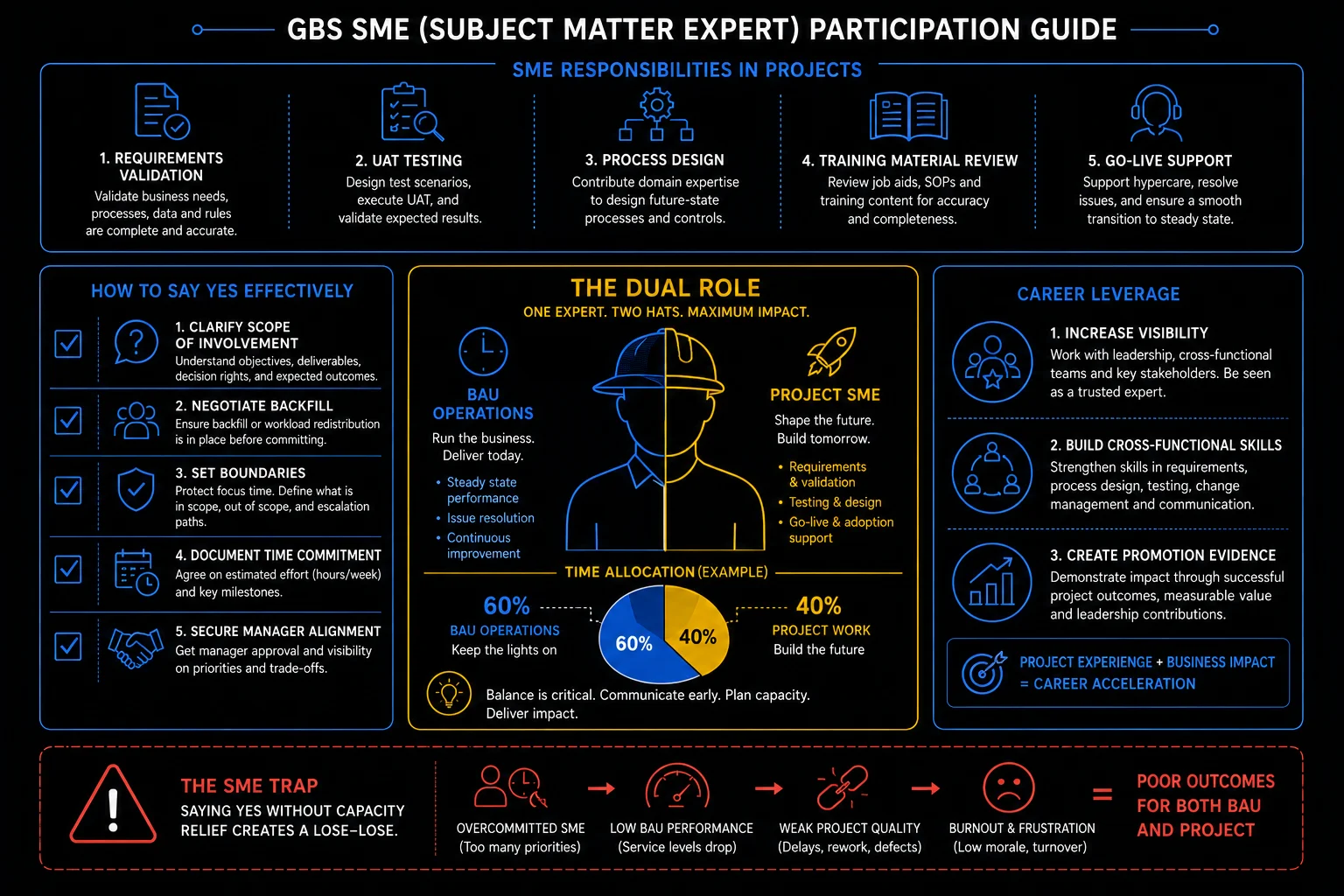
SME participation guide — the dual role, career leverage, and the SME trap
Sound familiar?
Topic 01 · Dual Demands
Balancing BAU with project work
SME on a project while running BAU is the most common overload in GBS. Protected time, agreed upfront, is the survival mechanism. Read how to solve this in the section below!
Full-time BAU. Part-time project.
The math never worked.
 P
PPriya’s project meetings collide with month-end close. Both bosses assume the other flexed.
She works evenings to serve both. Neither notices — each sees only their half delivered.
Week six: exhausted, and somehow behind on both sides.
"The overload was invisible because I kept absorbing it."
She feels depleted — by an agreement nobody ever made.
You handle your normal job and the project work at the same time without complaining. Because you manage it, nobody notices the workload is unsustainable — your competence hides the fact that the staffing plan is wrong.
SME survival is a negotiated allocation, made visible.
One three-way conversation sets the split. The next collision becomes their scheduling problem — as it always should have been.
Balancing BAU and project work in depth
Nobody reduces your BAU workload when they add project work. You need to negotiate the balance explicitly — or you will be held accountable for both and resourced for neither.
- Get written allocation — "You will spend 40% of your time on the project" needs to be documented and agreed with both your BAU manager and project manager
- Define coverage — who handles your BAU work during project allocation? If nobody, the allocation is fictional.
- Set boundaries — project meetings during peak BAU periods (month-end close, audit weeks) need to be protected
- Track time — document hours spent on project vs BAU so that overallocation is visible and defensible
- Escalate early — if both sides demand 100%, escalate to the governance level that can arbitrate
The dual role — BAU operations + project SME
Career leverage — visibility, cross-functional skills, promotion evidence
If you are double-loaded: request the three-way allocation talk this week. Bring a proposed percentage.
Time protected. Now the SME task that decides go-live.
Topic 02 · Testing
User Acceptance Testing best practices
UAT is where your process knowledge earns its seat: test real scenarios, log honestly, and sign off only what is true. Read how to solve this in the section below!
Your signature on the UAT
is the last gate before go-live.
 A
AAmara gets a UAT script of happy-path cases. Everything passes. Something feels thin.
She adds her real Mondays: the duplicate customer, the partial payment, the credit note chain.
Three fail. Uncomfortable meeting — six weeks before it would have been a live crisis.
"I did not test the system. I tested my actual job against it."
She feels essential — the word SME finally means something.
You test the new system using the test script the project gave you, not your actual daily work. You sign off, the system goes live, and on Monday you discover it cannot handle your real scenarios.
SME-grade UAT has three disciplines.
The three failures get fixed pre-go-live. Hypercare is quiet — and everyone knows whose test cases made it so.
UAT best practices in depth
UAT is where the rubber meets the road — testing whether the system actually works for the people who will use it daily. As the SME, your job is to test real scenarios, not just happy paths.
- Test with real data — test scripts using sanitized production data reveal issues that synthetic test data never will
- Test exceptions, not just standard flows — the standard process probably works; the edge cases are where bugs hide
- Document everything — screenshots, error messages, steps to reproduce. "It does not work" is not a defect report.
- Prioritize defects — distinguish between showstoppers (process cannot complete), major (workaround exists but painful), and minor (cosmetic or inconvenient)
- Do not sign off until critical defects are resolved — UAT sign-off means you are confirming the system is ready for production. Your name is on it.
Project teams under timeline pressure will push for UAT sign-off before all defects are resolved.
- →Your sign-off is your professional certification that the system works.
- →Do not sign off on a system that will fail your team in production.
- →Escalate to the steering committee if necessary — that is exactly what steering committees are for.
The SME trap — saying yes without capacity relief
List your five ugliest real scenarios. They are your UAT script, whenever it comes.
Pillar 8 complete. Projects change the work — Pillar 9: risk guards it.
- When you get pulled onto a project as an SME, the biggest mistake is treating it as an inconvenience. It is an audition. The project leaders are watching who shows up prepared, who flags issues early, and who makes their life easier. That is your next career move sitting right there.
- Negotiate your workload split before saying yes to project work. Get it in writing with your manager. "I will dedicate 40% to the project" means nothing if your BAU KPIs are not adjusted. Without that agreement, you carry double the load and get credit for neither.
- Document everything you contribute to the project. Project work has a shelf life — once it is over, people forget who did what. Your Brag Sheet should capture every deliverable, every decision you influenced, every issue you caught. That is career currency.
Reference
Glossary
Full glossary at the GBS Insider Club Field Guide.
- ISTQB — Foundation Level Syllabus, User Acceptance Testing section
- PMI — PMBOK Guide, Quality Management Knowledge Area
- SSON — GBS Transformation Best Practices, 2025
Knowing the frameworks is the entry ticket. Applying them — visibly, at your actual job — is what gets you promoted.
The GBS Insider Club Career Playbooks turn this theory into a guided 90-day program for your role: self-assessment, practical exercises, templates, and Julian's unfiltered practitioner playbook.
Explore the Career Playbooks → Back to Projects and Transformation